
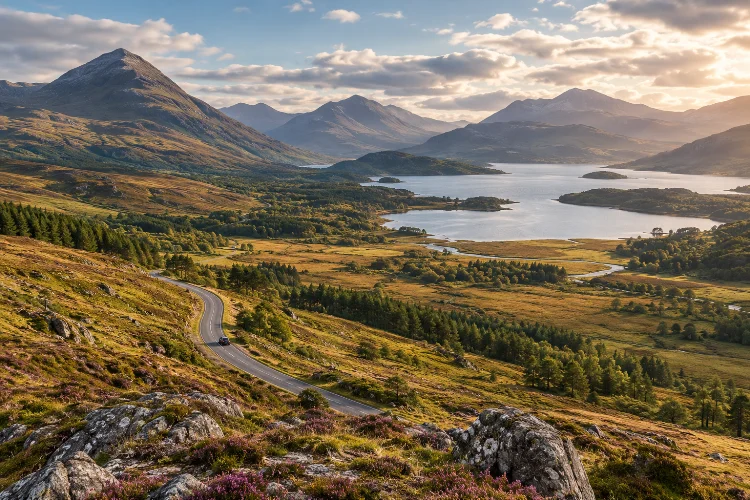
Scotland is easy to underestimate on a map.
Distances between Highland towns may look short, but once you add single-track roads, mountain passes, photo stops, woodland walks, and the sudden urge to spend an hour beside an unnamed loch, a simple drive can fill an entire day.
That is exactly why planning extended road trips through Scotland’s National Scenic Areas works so well. Instead of racing between famous landmarks, you can build a journey around landscapes officially recognised for their outstanding scenery.
Scotland has 40 National Scenic Areas, covering about 13% of the country’s land. They range from rugged mountain regions such as Ben Nevis and Glencoe to island landscapes, Highland glens, dramatic coastlines, and the vast Cairngorm Mountains.
For road trippers, several mainland areas can be connected into one remarkable 10- to 14-day journey.
The best approach is simple: choose fewer bases, drive shorter distances, and leave enough empty space for weather and spontaneous detours. In Scotland, the road between two scenic areas is often just as memorable as the destination.
Why National Scenic Areas Are Perfect for a Longer Road Trip
A National Scenic Area, or NSA, is not the same thing as a national park.
The designation identifies landscapes considered to have outstanding scenic value in a national context and helps protect their special qualities through Scotland’s planning system. NatureScot describes them as some of the country’s finest landscapes.
For travellers, that creates an interesting advantage.
You are not following one branded tourist route from beginning to end. Instead, National Scenic Areas are spread across the country, which means you can connect mountains, forests, coastlines, lochs, and remote villages into your own itinerary.
NatureScot highlights everything from gentle riverside walks in the River Tay NSA to wilder landscapes in Wester Ross and Assynt-Coigach. In Assynt, for example, the Stac Pollaidh area provides huge views over a distinctive landscape of isolated mountains and countless small lochs.
This variety is what makes an extended trip worthwhile.
A three-day journey encourages you to keep moving. A two-week journey lets you wake up in Glencoe, spend half a day walking, wait for rain to clear, and stay another night simply because the landscape looks completely different in evening light.
That is not wasted time.
It is usually the best part of the trip.
Start With Ben Nevis and Glencoe for Maximum Highland Drama
If you are beginning from Glasgow or central Scotland, Glencoe provides an almost unfairly dramatic introduction.
The road north gradually becomes wilder before crossing the open landscapes around Rannoch Moor and descending into the famous pass. Huge mountain walls rise close to the road, with waterfalls appearing after rain and cloud moving quickly across the ridges.
Ben Nevis and Glencoe form one of Scotland’s National Scenic Areas, and the broader Glencoe landscape was shaped by ancient volcanic activity and later glaciation.
Do not treat it as a roadside photo stop.
Stay two or three nights.
Glencoe village works as a useful base, while nearby Ballachulish and Fort William provide additional accomodation, food, and practical services. From here you can explore Glen Coe itself, Glen Etive, Loch Leven, Rannoch Moor, and the wider Lochaber landscape.
Use One Day Without a Driving Target
One of the best decisions you can make on a long road trip is intentionally scheduling a day where the car barely moves.
Walk around Glencoe Lochan, explore a lower glen route, or choose a more substantial hike if your skills and conditions are appropriate.
VisitScotland describes Glencoe as a base for everything from woodland trails to serious mountain days and notes that Fort William is only around half an hour away.
This gives you flexibility.
If the mountains disappear completely into cloud, spend time at lower elevations. If conditions suddenly improve, you have not committed yourself to four hours of driving somewhere else.
That rhythm—drive, stay, explore—is much more satisfying than changing hotels every night.
Make Glen Affric a Deliberate Detour
Glen Affric requires a little more effort to fit into a wider road trip, which is precisely why you should give it time.
The glen combines mountains, lochs, rivers, and one of Scotland’s finest surviving areas of Caledonian woodland. Forestry and Land Scotland describes the forest as one of the best examples of the native woodland that once covered much more of the country.
A sensible base is around Cannich or the wider Loch Ness area.
From Cannich, a minor road heads into Glen Affric, eventually reaching River Affric at the end of the public road. Forestry and Land Scotland says River Affric lies around 10 miles from Cannich, with much of the route being single track.
This is not a road to rush.
Use passing places properly, watch for walkers and cyclists, and remember that the slow speed is part of the experience.
Park the Car and Continue on Foot
Once you reach River Affric, the character of the trip changes.
The public road ends and the mountains open ahead. Short viewpoints are available near the parking areas, while longer walking routes move deeper into the glen.
Forestry and Land Scotland also warns that mobile reception is limited and that there are no cafés or shops inside Glen Affric itself. Food and other supplies should be picked up around Cannich or Tomich.
That may sound inconvenient.
In reality, it is part of Glen Affric’s appeal.
Pack lunch, download maps beforehand, and allow a full day. You will enjoy the place much more when you are not constantly calculating how quickly you can reach your next hotel.
Cross the Cairngorm Mountains Using the SnowRoads
After western Highland glens, the Cairngorms provide a completely different driving experience.
The landscape feels broader and more open. Instead of narrow sea lochs and steep western mountains, you find high roads, expansive moorland, forests, rivers, and communities spread through long valleys.
The Cairngorm Mountains form another National Scenic Area.
For a road trip, one of the most enjoyable ways through the eastern side is the SnowRoads Scenic Route.
The route covers around 90 miles between Blairgowrie and Grantown-on-Spey, connecting places including Braemar, Ballater, and Tomintoul. The Cairngorms National Park Authority notes that it follows some of Britain’s highest public roads.
VisitScotland estimates around three hours of uninterrupted driving for the full route.
Do not complete it in three hours.
Give it at least a full day, ideally two.
Stay Around Braemar or Ballater
Braemar makes a strong base for walkers and anyone interested in mountain scenery.
Ballater adds cafés, shops, riverside walks, and easy access to the wider Deeside landscape. Tomintoul works well if you prefer somewhere smaller and want to continue north toward Speyside.
The high roads deserve respect.
The Cairngorms National Park explicitly reminds travellers that the route is called SnowRoads for a reason and recommends checking weather forecasts and travel warnings because its high sections can be affected by severe conditions.
Even outside winter, Scottish mountain weather can turn quickly.
This is another reason extended itineraries outperform rigid ones.
If the high road looks unpleasant, stay another morning in the valley rather than forcing the schedule.
Slow Down in Wester Ross Instead of Simply Following the NC500
Wester Ross is where a Scottish road trip can become dangerously addictive.
One minute you are beside a sea loch. Twenty minutes later you are surrounded by mountains, passing woodland, beaches, small crofting communities, or another road that looks interesting enough to derail your entire itinerary.
The Wester Ross National Scenic Area contains some of Scotland’s most impressive mountain landscapes. NatureScot specifically highlights locations such as the Triple Buttress of Coire Mhic Fhearchair and Corrieshalloch Gorge as ways to experience the area.
The road network here overlaps with sections of the famous North Coast 500, but an extended scenic-area trip should not become obsessed with completing the NC500.
Instead, base yourself for two or three nights around Torridon, Gairloch, or Ullapool.
Explore locally.
The landscapes around Torridon alone can easily consume a day without any need for major mileage.
Treat Applecross as an Option, Not an Obligation
The Applecross Peninsula is spectacular, but some roads are narrow and demanding.
If your vehicle, experience, or the day’s weather makes a particular route uncomfortable, choose another.
There is no prize for driving every celebrated Highland road.
The point of Wester Ross is not collecting famous bends. It is experiencing the relationship between mountains, coastline, settlements, and huge open spaces.
Leave enough time to stop for short walks.
A 30-minute trail away from a lay-by often produces a better memory than another 60 miles behind the wheel.
Give Assynt-Coigach Several Days, Not Several Hours
Assynt-Coigach looks almost unreal after the continuous mountain landscapes farther south.
Individual peaks seem to rise directly from enormous areas of rock, peat, moorland, and water.
Suilven, Stac Pollaidh, Quinag, Cul Mor, and Canisp have distinctive shapes, while countless lochans reflect rapidly changing skies.
NatureScot identifies Assynt-Coigach as one of Scotland’s outstanding scenic landscapes and highlights the panorama from Stac Pollaidh as one of the best ways to appreciate its characteristic mountain-and-lochan geography.
Stay around Ullapool or Lochinver.
Ullapool is more practical for services and onward travel, while Lochinver places you closer to smaller coastal roads and mountain scenery.
Two nights is the minimum I would build into an extended trip.
Three or four is better.
Don’t Measure Assynt in Road Miles
The mistake here is thinking, “It’s only 40 miles.”
Forty miles of Highland driving can include single-track sections, passing places, sheep, beaches, photography stops, café breaks, and sudden decisions to walk toward a waterfall.
The North and West Highlands Route promoted by VisitScotland runs about 158 miles between Ullapool and John o’ Groats, but its stated drive time of around three hours and 45 minutes is only useful as a measure of uninterrupted driving – not as a realistic sightseeing day.
An extended itinerary should use those numbers as a warning against overplanning.
Drive less.
Stop more.
A Practical 12-Day National Scenic Areas Itinerary
A 12-day trip gives you enough structure without turning every day into a transfer.
Spend the first two nights around Glencoe. Use the arrival day to explore the glen and the following day for walking, Glen Etive, or a wider Lochaber excursion.
On day three, move north toward Loch Ness and Cannich. Stay for two nights so day four can be dedicated almost entirely to Glen Affric.
Days five and six can shift east into the Cairngorms. Pick Braemar, Ballater, Aviemore, or another suitable base depending on whether you prioritise SnowRoads driving, walking, wildlife, or villages.
Move toward Inverness or directly west on day seven.
Days seven to nine can then focus on Wester Ross. Staying around Torridon or Gairloch keeps the mountains close, while Ullapool is more convenient if you want easier access to both Wester Ross and Assynt.
Spend days ten and eleven exploring Assynt-Coigach.
Keep day twelve flexible for the return journey or whichever region received the worst weather earlier in the trip.
This last day matters more than it sounds.
If Wester Ross was hidden under heavy rain for two days, you can change the route. If Glencoe delivered everything you wanted, spend longer in Assynt instead.
An extended itinerary is valuable because you can still change your mind.
Don’t Confuse Driving Time With Exploration Time
Mapping software is excellent at telling you how long a journey might take without meaningful stops.
Unfortunately, meaningful stops are the entire reason you are in Scotland.
If an app says three hours, do not automatically plan a major hike, two castles, a long lunch, and sunset photography afterward.
Scotland’s recognised scenic driving routes demonstrate the difference clearly.
VisitScotland lists the 129-mile Argyll Coastal Route at just under three hours of pure driving, the 90-mile SnowRoads at around three hours, and the 158-mile North and West Highlands Route at around three hours and 45 minutes.
Nobody interested in scenery should drive those routes at that pace.
For an extended trip, aim for shorter transfer days.
Three or four hours behind the wheel is plenty when combined with several stops.
Some days should contain barely any driving at all.
Your trip will feel longer in a good way.
Plan Around Single-Track Roads, Fuel, and Limited Reception
Remote Highland roads are usually manageable when drivers are patient.
Passing places are there for vehicles to pass one another, not for parking or photographing scenery. If a faster local vehicle appears behind you, allow it to pass safely rather than increasing your speed.
Places such as Glen Affric provide a useful preview of what this type of travel requires.
Forestry and Land Scotland specifically advises visitors to drive slowly on its single-track access road and use passing places correctly.
Download offline maps before entering remote areas.
Mobile coverage can disappear, and route changes become much easier when your navigation does not depend on a live connection.
Fuel planning is also neccessary.
You do not need to drive around with a collection of emergency fuel cans, but filling up in larger towns before entering remote western regions is sensible.
Carry food and water too.
The café you saw online may be closed, seasonal, or much farther away than expected.
Pick Your Season Based on the Kind of Trip You Want
Late spring is excellent for extended road trips.
Days are long, vegetation is fresh, and you can spend hours outside after dinner.
Summer gives you maximum daylight but also brings the greatest pressure on popular destinations and accomodation. Booking several key bases in advance is sensible, particularly in small western communities.
Autumn changes everything.
Glen Affric becomes especially attractive when woodland colours shift, while lower light can make mountain landscapes feel more textured and dramatic.
Winter can be spectacular but requires a much more conservative plan.
High roads in the Cairngorms can close because of snow, daylight is short, and weather may make some remote journeys impractical. The SnowRoads guidance specifically recommends checking current weather and road conditions because of the route’s elevation.
Whatever the season, avoid creating an itinerary where every accommodation booking depends on perfect weather.
Scotland will eventually win that argument.
Travel Responsibly Through Protected Landscapes
National Scenic Area status exists partly because these landscapes have exceptional value.
That does not mean they are empty wilderness.
People live and work in them.
Crofts, farms, forestry operations, conservation projects, estates, villages, small businesses, and transport routes all share the same landscape visitors have come to enjoy.
VisitScotland’s road-trip guidance asks travellers to plan ahead, use proper parking and camping locations, take rubbish away, and follow the Scottish Outdoor Access Code.
That is not difficult.
Park where you are supposed to. Never block gates or passing places. Avoid damaging soft verges simply because a viewpoint looks convenient.
Spend locally whenever possible.
A two-night stay, village café lunch, local shop visit, or small guesthouse booking leaves more value within communities than a quick photograph followed by another hundred miles of driving.
Slower travel generally creates a better trip and a lighter impact.
Those two things fit together surprisingly well.
Planning extended road trips through Scotland’s National Scenic Areas is less about creating the perfect route and more about creating enough time for the route to change.
Glencoe delivers huge mountain drama, Glen Affric combines native woodland and remote glens, the Cairngorms offer high roads and open landscapes, while Wester Ross and Assynt-Coigach bring some of Scotland’s most extraordinary mountain-and-coast scenery.
The common mistake is trying to connect all of them too quickly.
Stay two or three nights in key regions, keep daily mileage modest, and reserve at least one flexible day for weather or spontaneous discoveries.
Start by choosing three or four National Scenic Areas that genuinely interest you, then design the road between them. The slower you travel, the more Scotland tends to reveal.