
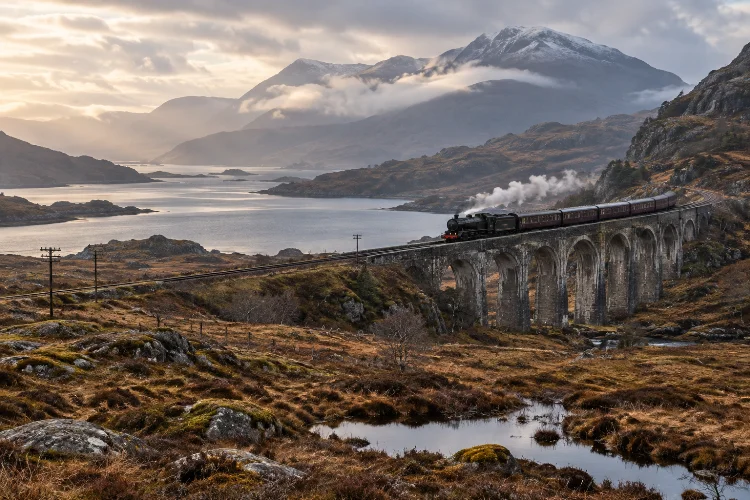
Some of Scotland’s wildest landscapes were connected by railway long before scenic train travel became a bucket-list experience.
Victorian engineers pushed tracks across peat bogs, cut through rock beside sea lochs, climbed into the Grampian Mountains, and built stations in places where even today there may be little more than a platform, a road, and miles of open country.
That history makes discovering Scotland’s historic railway routes and remote landscapes much more interesting than simply booking a window seat.
The West Highland Line shows how railways opened up isolated western communities and fishing ports.
The Kyle Line crosses the country from Inverness to the Atlantic coast, while the Far North Line travels through sparsely populated Sutherland and across the Flow Country. The Highland Main Line, meanwhile, helped transform travel between central Scotland and Inverness.
These routes are still practical transport links, not museum exhibits. Yet they also function like moving history lessons.
Travel slowly, get off at smaller stations, and the railway begins to reveal how transport changed Highland communities, tourism, trade, and people’s relationship with landscapes that once took far longer to cross.
Why Scotland’s Highland Railways Were Such a Big Deal
It is easy to romanticise railway construction when looking through a comfortable train window.
The reality was difficult.
Building railways through the Highlands meant solving problems created by mountains, deep glens, sea lochs, unstable peat, harsh weather, and tiny populations that could not always guarantee profitable passenger numbers.
But the potential benefits were enormous.
Before railways, moving people, livestock, fish, mail, and goods between remote Highland communities and major cities could be slow and expensive. Rail links dramatically shortened those journeys.
The railway also changed tourism.
Victorian travellers could reach landscapes that previously required long coach journeys or complicated combinations of roads and boats.
Hotels appeared around stations, fishing and sporting estates became more accessible, and places such as Aviemore eventually developed into major tourism centres.
Today’s Scottish network still reflects many of those historic corridors. ScotRail’s current scenic railway map identifies the West Highland, Kyle, Far North and Highland Main lines as key routes connecting remote Highland destinations with Glasgow, Perth and Inverness.
The important thing is to see these lines as more than transport.
They were pieces of infrastructure that changed how entire regions functioned.
The West Highland Line: Building a Railway Into the Wild
The West Highland Line is probably Scotland’s most famous scenic railway.
Travel north from Glasgow and urban landscapes gradually disappear. Lochs, forests and increasingly high mountains begin to dominate as the line moves toward Crianlarich and the western Highlands.
Beyond there, the railway becomes particularly dramatic.
One branch continues toward Oban, while the northern route passes through places such as Tyndrum, Bridge of Orchy, Rannoch and Corrour before reaching Fort William.
Rannoch Moor is where the line starts to feel genuinely isolated.
Huge areas of peat and moorland stretch toward distant mountains, and the railway appears almost impossibly exposed within the landscape.
That sense of remoteness is part of what made construction such an impressive engineering achievement.
Glenfinnan and the Mallaig Extension
The Fort William–Mallaig section came later and pushed the railway all the way to Scotland’s western seaboard.
Its most famous structure is the Glenfinnan Viaduct.
Network Rail describes it as Scotland’s longest mass-concrete railway bridge. Built during the late Victorian railway era, it stretches for 416 yards, contains 21 semicircular spans and rises roughly 100 feet above the valley.
Today, millions recognise it from the Harry Potter films.
Historically, though, its significance goes much deeper.
The Mallaig extension helped transform a small west-coast fishing settlement into a much busier port. Fish could be transported rapidly toward major markets, while businesses and population grew around improved transport links.
That is worth remembering while crossing the viaduct.
The structure was not built to become a film location.
It was built to connect remote communities with wider economic networks.
Stop Instead of Riding Straight Through
Many visitors travel from Glasgow or Fort William to Mallaig and immediately return.
That works if time is limited, but staying overnight makes the railway much more meaningful.
Glenfinnan is worth a stop for walks, the monument and views toward Loch Shiel. Mallaig provides ferry connections, harbour life and access to nearby coastal landscapes.
Corrour is another fascinating option for experienced walkers.
Its railway station sits in exceptionally remote moorland, giving passengers the unusual possibility of stepping off a scheduled train directly into a huge Highland landscape.
Just check return trains carefully.
Remote stations do not operate like city metros, and missing a service can turn a casual detour into a very long wait.
The Kyle Line: From Inverness to the Atlantic Edge
The Kyle Line has a completely different personality.
It begins in Inverness, travels through Dingwall, and then turns west through increasingly rugged Highland country before eventually reaching Kyle of Lochalsh.
The railway was not constructed all at once.
The original Dingwall-to-Stromeferry section opened in 1870. From there, boats connected passengers and goods with Skye and the islands. Work on the difficult final extension toward Kyle began in 1893, and the complete route opened in 1897.
The final ten-mile stretch was especially challenging.
According to Kyle Station Museum, it required 29 bridges and more than 30 rock cuttings, making it an exceptionally expensive piece of railway engineering for its period.
Looking through the window today, you can understand why.
The route passes through narrow landscapes where mountains, rock and water leave very little obvious room for a railway.
How the Railway Changed Kyle of Lochalsh
Before the line arrived, Kyle was a tiny settlement.
The railway and pier transformed it into an important transport centre linking mainland rail services with ferries and island communities.
Fish, livestock, passengers and other goods could move much more quickly between the west coast and cities farther south. Kyle Station Museum notes that fresh fish could eventually reach London’s Billingsgate Market within about a day of being landed.
This is one of the clearest examples of railway infrastructure reshaping a Highland community.
When you reach Kyle today, walk down toward the waterfront rather than simply waiting on the platform.
The relationship between railway, pier and sea makes the historical logic much easier to understand.
The Scenic Section Around Loch Carron
The scenery becomes particularly impressive toward the western end.
The railway follows Loch Carron, with hills rising steeply around the water, before continuing through Plockton and toward Kyle.
ScotRail describes the journey as moving through woodland and glens before opening into wild mountain scenery and coastal views.
Plockton is worth considering for an overnight stop.
It gives you a quieter base with shoreline walks and easy rail access while allowing you to continue toward Kyle the following day.
If you have more time, Kyle also works as a gateway to Skye and Eilean Donan, although onward buses or other transport need to be planned seperately.
The Far North Line: Railway Travel at the Edge of Britain
The Far North Line is less instantly dramatic than Glenfinnan, but it may feel even more remote.
From Inverness, trains head north through Dingwall and continue along the east coast through towns such as Tain, Golspie, Brora and Helmsdale.
Then the railway turns inland.
The landscape becomes wider and emptier as the line enters northern Sutherland and the Flow Country before eventually dividing for Thurso and Wick.
The final northern section was completed in 1874, meaning the route has now connected these communities for more than 150 years. The Far North Line Community Rail Partnership highlights the section between Kinbrace and Altnabreac as one of Britain’s most remote railway corridors.
In places, there is barely any road nearby.
Old railway workers’ cottages remain as reminders that people once had to live close to the track simply to maintain such an isolated piece of infrastructure.
The Flow Country Changes the Experience
The Flow Country does not look like the classic image of Highland mountains.
That is exactly why it is interesting.
Vast peatlands extend across the landscape, broken by pools, rivers and distant low hills. The scale is difficult to appreciate from photographs but becomes obvious when you spend a long time travelling through it.
Forsinard is one of the most useful stops if you want to leave the train and understand the landscape more closely.
ScotRail’s current scenic journey map highlights the Forsinard reserve and the wider Flow Country among the major experiences accessible from the Far North Line.
Farther south, Dunrobin Castle and Helmsdale provide entirely different historical stops.
That variety makes the Far North Line excellent for slow travel.
Instead of treating Inverness–Thurso as one long journey, divide it into stages.
Don’t Try to Force It Into a Day Trip
The line is long and services are limited compared with busy urban railways.
Older ScotRail route analysis has explicitly noted that Wick and Thurso are difficult to treat as comfortable day trips from Inverness because of journey length.
Stay overnight instead.
Thurso can be combined with north-coast exploration, while Wick offers harbour history and another base for Caithness.
The railway becomes far more enjoyable once you stop worrying about getting back to Inverness before bedtime.
The Highland Main Line: The Route That Connected Perth and Inverness
The Highland Main Line is sometimes overshadowed by the more famous western routes.
Historically, it is hugely important.
The Inverness and Perth Junction Railway was completed in stages in 1863, finally creating a direct rail connection through difficult Highland terrain. Engineer Joseph Mitchell was central to the project, and much of the challenging route was constructed remarkably quickly.
The line changed travel between the Highlands and central Scotland.
Today, passengers pass Pitlochry, Blair Atholl, Dalwhinnie, Newtonmore, Kingussie and Aviemore before continuing toward Inverness.
The scenery changes gradually.
Wooded Perthshire gives way to broader upland valleys, high passes and the open landscapes around the Cairngorms.
Aviemore Makes an Ideal Historic Railway Stop
Aviemore is one of the best places to interrupt the journey.
The town provides access to Cairngorms National Park, but it also connects neatly with Scotland’s railway heritage.
The original Highland Main Line followed a different route north from Aviemore. Part of that former railway has been preserved by the Strathspey Railway.
Heritage trains now travel from Aviemore through Boat of Garten toward Broomhill, following roughly 20 miles on a return journey through woodland, moorland and River Spey scenery.
That creates an interesting contrast.
In the morning, you can arrive on a modern scheduled service.
In the afternoon, you can board a steam or heritage diesel train over infrastructure connected with an older Highland railway alignment.
The route also demonstrates how railway preservation can keep historic infrastructure alive after parts of the original network closed.
The Oban Branch: An Underrated West Highland Journey
Mallaig receives most of the attention, but the West Highland branch toward Oban deserves more recognition.
After the railway divides at Crianlarich, the Oban route continues through Glen Lochy and toward Loch Awe.
VisitScotland highlights views of Loch Lomond, Glen Falloch, Glen Lochy and the landscape around Kilchurn Castle among the attractions associated with the journey.
Oban itself makes the route even more useful.
The railway terminates close to the harbour, where ferries connect with islands including Mull and other parts of the Inner Hebrides.
This creates an easy rail-and-ferry itinerary without requiring a car.
Spend two nights in Oban and the railway becomes the beginning of the trip rather than the final attraction.
There is also historical logic to this.
Railways and steamship connections worked together to make western Scotland and the islands more accessible. Stations near ports were effectively gateways between inland rail travel and maritime transport.
That relationship remains visible today.
Heritage Railways Show What Modern Routes Have Lost
Scheduled passenger trains are excellent for seeing remote Scotland, but heritage railways add another layer.
The Strathspey Railway is the obvious Highland example, yet Scotland has several preserved lines where vintage locomotives, old stations and restored infrastructure help explain what railway travel once felt like.
These journeys are generally shorter and slower.
That is the point.
Instead of using the train mainly to reach somewhere else, the railway itself becomes the attraction.
The Strathspey journey from Aviemore toward Boat of Garten and Broomhill takes just under two hours for a return trip and passes forests, moorland and River Spey scenery with the Cairngorms nearby.
You should still check operating calendars carefully.
Heritage lines do not necessarily run every day, and steam services may alternate with heritage diesel operations.
Booking before arranging non-refundable accomodation is neccessary if the railway is a major reason for your trip.
How to Build a Historic Railway Itinerary Across the Highlands
The temptation is to do everything.
Glasgow to Mallaig.
Mallaig back to Glasgow.
Glasgow to Inverness.
Inverness to Kyle.
Kyle back to Inverness.
Then Thurso.
Technically possible.
Emotionally questionable.
A better itinerary gives each railway its own space.
A Relaxed 8–10 Day Route
Start in Glasgow and take the West Highland Line north.
Spend one or two nights in Fort William or continue to Mallaig and stay there. If time allows, stop at Glenfinnan rather than experiencing the viaduct exclusively through a train window.
Then reposition toward Aviemore.
Spend two nights there, using one day for Cairngorms scenery and the Strathspey heritage railway.
Continue to Inverness.
From Inverness, choose the Kyle Line first and spend a night around Plockton or Kyle of Lochalsh.
Return east and then dedicate the remaining days to the Far North Line, ideally breaking the journey somewhere around Helmsdale or continuing for an overnight stay in Thurso or Wick.
This itinerary will not be perfectly efficient.
That is a good thing.
Historic railway travel is much more enjoyable when every day is not built around catching the earliest possible departure.
Practical Tips for Remote Scottish Train Travel
Check timetables shortly before travelling.
Highland routes have far fewer services than the busy Edinburgh–Glasgow corridor, and engineering work can occasionally change schedules.
Booking in advance can also reduce fares on some journeys. VisitScotland recommends advance purchasing as one way of finding cheaper Scottish train travel.
Carry snacks and water.
A rural station shown clearly on a map may have very limited facilities, and some request stops or small stations consist of little more than platforms and shelters.
Offline maps are useful too.
Mobile reception is inconsistent across remote terrain, especially when the railway moves between mountains.
Pack for getting off the train rather than only sitting inside it.
Waterproof clothing, comfortable footwear and a light daypack make spontaneous walks much easier.
And allow generous connection times.
Missing a train in Edinburgh might mean waiting twenty minutes.
Missing one on a remote Highland route can rearrange the entire afternoon.
The timetable should definately be treated as part of your travel planning rather than background information.
When Is the Best Time to Explore Scotland by Rail?
Late spring is an excellent all-round choice.
Days are long, vegetation is fresh and there is plenty of evening light after reaching your destination.
Summer provides the longest daylight but also brings greater demand for popular routes, accommodation and attractions.
Autumn is particularly attractive around woodland sections of the Highland Main Line and Speyside.
The shorter days are balanced by warmer landscape colours and lower-angle light.
Winter can be spectacular.
Snow around the Cairngorms or West Highlands can transform familiar routes completely. But shorter daylight, storms and potential travel disruption mean itineraries should remain flexible.
There is no need to wait for perfect sunshine.
Low cloud, rain and mist are part of the Highland enviroment. From a train window, they often make the landscape more atmospheric.
The railway allows you to enjoy those conditions without spending the entire day driving through them.
Why These Routes Still Matter
Historic railways are easy to reduce to nostalgia.
Steam locomotives, old photographs and Victorian station signs are charming, but the surviving lines are important because they still connect real communities.
The Kyle Line continues linking Inverness with settlements across the northwest.
The Far North Line still provides rail access to Sutherland and Caithness.
The West Highland Line serves communities that would otherwise rely much more heavily on long road journeys.
That makes travelling these routes different from visiting a static industrial museum.
You are using historic infrastructure that still performs its original basic function: connecting people and places.
The scenery is spectacular.
But the railway’s survival is part of the story too.
Discovering Scotland’s historic railway routes and remote landscapes reveals how engineering changed the Highlands just as much as roads, castles or canals did.
The West Highland Line crosses mountains and moorland before reaching Mallaig. The Kyle Line shows how rail and sea transport transformed the west coast, while the Far North Line pushes into some of Britain’s most sparsely populated territory.
The Highland Main Line connects those remote landscapes with the historic railway corridor toward Perth, and preserved routes such as the Strathspey Railway keep another generation of railway history alive.
The best way to explore them is slowly.
Choose two or three routes, stay overnight near smaller stations, and actually step into the landscapes outside the window.
Start with the railway timetable, leave some space between connections, and let the track decide where your next Highland journey goes.