
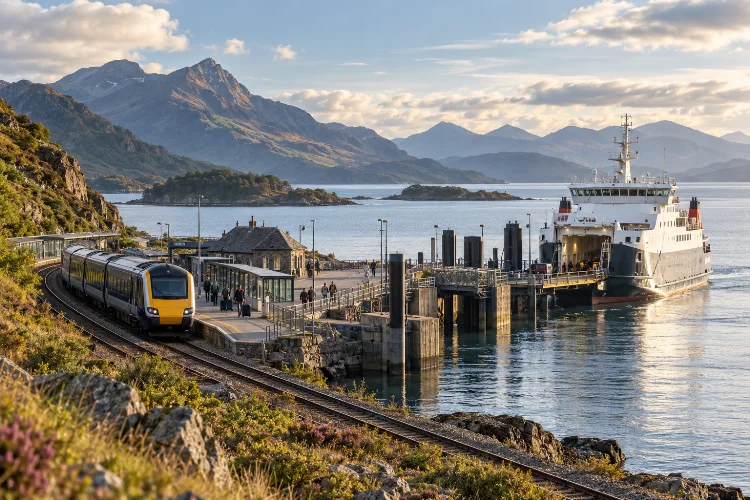
Scotland’s west coast looks complicated on a map.
Mountains interrupt roads, sea lochs cut deep into the mainland, and dozens of islands sit beyond channels that make a simple straight-line journey almost impossible. Yet this geography is exactly what makes travelling here by train and ferry so rewarding.
Instead of treating boats and railways as separate forms of transport, you can combine them into one continuous adventure.
Exploring Scotland’s west coast through ferry and railway connections lets you travel from Glasgow into the Highlands, arrive directly at working harbours such as Oban and Mallaig, then continue across the water toward Mull, Skye, the Small Isles, or even the Outer Hebrides.
The journey itself becomes part of the experience.
You might cross Rannoch Moor by train in the morning, watch fishing boats in Mallaig at lunch, and step off a ferry on an island that afternoon.
Better still, much of this can be done without driving.
The key is allowing enough time between connections, checking seasonal timetables, and resisting the urge to turn every ferry and train into a tight same-day transfer.
Why Rail and Ferry Travel Fits the West Coast So Naturally
The western Highlands were shaped by water long before modern roads arrived.
Sea lochs and channels that appear to divide communities today were once important travel corridors. Boats connected islands and coastal settlements while difficult mountain terrain made many overland journeys slow.
Railways later connected these maritime routes with Scotland’s larger cities.
That relationship is still visible.
ScotRail’s current network links Glasgow directly with Oban, Fort William, and Mallaig on the West Highland network. From Oban and Mallaig, ferry routes spread outward toward islands and peninsulas.
This makes a car-free journey surprisingly logical.
You can leave Glasgow Queen Street, watch Loch Lomond and the Highland landscape pass outside the window, and eventually walk from a railway station toward a ferry terminal without hiring a vehicle.
There is also a practical benefit.
Driving Highland roads can be enjoyable, but it requires concentration. Train and ferry travel gives everyone in the group a chance to watch the scenery rather than assigning one person to spend hours looking at bends, passing places, and traffic.
The trade-off is flexibility.
A car can leave whenever you want. Trains and ferries work to published schedules, and west-coast weather can affect maritime services.
That means planning matters more – but the reward is a journey that feels connected to the geography rather than simply moving through it.
Glasgow to Oban: The Easiest Rail-to-Ferry Introduction
Oban is probably the best place to begin if you have never combined Scottish rail and ferry travel before.
The West Highland railway leaves Glasgow and heads north beside increasingly dramatic scenery before reaching Crianlarich. There the route divides, with one section travelling toward Fort William and Mallaig while the other heads west toward Oban.
The Oban branch passes places such as Tyndrum, Dalmally, Loch Awe, Taynuilt, and Connel Ferry.
It is a journey that changes gradually rather than delivering one giant scenic reveal.
Urban Scotland disappears, mountain valleys widen, forests appear, and the landscape begins feeling noticeably more coastal as you approach Oban.
Then the train ends almost beside the harbour.
That is what makes Oban so convenient.
You do not arrive at a station miles inland and then need a complicated transfer. The railway and ferry functions of the town sit close together, making it relatively easy to continue toward the islands.
Oban to Mull
The most obvious onward ferry is the route from Oban to Craignure on Mull.
Caledonian MacBrayne operates the crossing, with multiple sailings depending on season and timetable. For the 2026 summer period, the published schedule covers late March through mid-October, although amended timetables can operate on particular dates.
For foot passengers, this can make Mull remarkably accessible without a car.
Arrive in Craignure and you can continue by island bus toward places such as Tobermory, although bus and ferry times should be checked together rather than assumed to connect perfectly.
CalMac specifically warns that train connections at Oban are not guaranteed, because some rail and sailing times do not provide enough transfer time.
That is probably the most useful planning lesson for this entire trip.
Do not build an itinerary around a heroic five-minute connection.
If missing one sailing would ruin your day, arrive earlier.
Better still, spend a night in Oban.
The harbour is worth experiencing anyway, and arriving the evening before transforms the ferry departure from a logistical sprint into a relaxed start to an island trip.
Use Oban as a Hub Rather Than Just a Transfer Point
Oban is often described as the “Gateway to the Isles,” and for a rail traveller that description is especially accurate.
Mull is the obvious destination, but it is not the only option.
CalMac also operates routes from Oban toward Lismore, while longer sailings connect the mainland with parts of the Outer Hebrides, including Castlebay on Barra during relevant timetable periods.
This means you can build very different trips from the same railway terminus.
A short itinerary might involve Glasgow, two nights in Oban, and a ferry excursion to Mull.
A longer journey could travel from Glasgow to Oban, continue by ferry into the Hebrides, spend several days moving between islands, and eventually return to the mainland elsewhere.
Lismore for a Quieter Detour
Lismore is an interesting alternative if Mull feels too ambitious.
The island lies much closer to Oban and receives regular ferry connections under the current timetable.
CalMac’s 2026 information also notes that some sailings can operate under amended tidal schedules, which is another reminder to check the exact travel date rather than memorising a generic timetable.
A quieter island can make a refreshing contrast with busier Highland destinations.
There is less pressure to “see everything.”
You can walk, explore the landscape, and return to Oban without trying to build an enormous sightseeing checklist.
This type of side trip works particularly well on an extended rail itinerary.
Not every destination needs to be famous.
Glasgow to Mallaig: The Most Dramatic Rail-and-Sea Connection
If Oban is the easiest introduction, Mallaig delivers the bigger railway adventure.
The West Highland Line from Glasgow to Mallaig takes just over five hours and crosses some of Scotland’s best-known scenery, including open moorland, mountain country, lochs, and the Glenfinnan Viaduct.
After Crianlarich, the northern branch travels through Bridge of Orchy, Rannoch, Corrour, and Fort William.
Rannoch Moor is particularly memorable because the railway enters a huge landscape with remarkably little development.
Corrour station feels even more remote.
Eventually, the train reaches Fort William beneath Ben Nevis before continuing west through Glenfinnan, Lochailort, Arisaig, and Morar toward the coast.
Mallaig station sits close to the ferry harbour.
Again, the railway does not simply end in an arbitrary town.
It ends at a maritime gateway.
Mallaig to Skye
The ferry from Mallaig to Armadale on the Isle of Skye is one of the most natural rail-to-ferry combinations in Scotland.
CalMac’s current 2026 schedule covers the summer season through 18 October, with winter services following afterward. Foot passengers are advised to book in advance and check in at least 10 minutes before departure.
The crossing is short compared with longer Hebridean voyages, but it completely changes the journey.
You leave a mainland fishing port and arrive on southern Skye with the mountains of the island ahead.
For travellers without a car, however, one important detail comes next: the ferry terminal at Armadale is not the end of your transport planning.
You need to coordinate onward buses, accomodation, or local transfers on Skye.
Do that before arriving.
Island transport can be perfectly workable, but it does not run with the frequency of an urban network.
Go Beyond Skye With the Small Isles Ferry
Mallaig is also the gateway to one of Scotland’s most interesting island groups.
CalMac operates sailings connecting Mallaig with Eigg, Muck, Rùm, and Canna, collectively known as the Small Isles. The 2026 summer schedule runs from 27 March to 18 October, followed by a winter timetable.
These routes are ideal for travellers who want the journey to feel genuinely maritime.
Unlike a quick hop across to Skye, the Small Isles network encourages you to think in terms of sailing days and island stays.
You cannot simply assume every island receives the same service every day.
This is where a slower itinerary becomes essential.
Stay Overnight Instead of Trying to Island-Hop Too Fast
A common planning mistake is looking at a map and assuming several islands can be visited consecutively like railway stops.
Ferry networks do not always work that way.
Some sailings visit multiple islands, schedules vary by day, and weather or operational changes can alter plans.
Choose one island and stay.
Rùm offers mountain landscapes and a strong sense of remoteness. Eigg has a distinctive community character and excellent walking. Canna and Muck provide even smaller-scale island experiences.
The details matter less than the strategy.
One island experienced properly is usually more satisfying than three islands seen mostly from ferry decks.
Build a 7-10 Day Car-Free West Coast Itinerary
A week is enough for a good combined rail-and-ferry journey.
Ten days makes it significantly more relaxed.
Days 1-3: Glasgow to Oban and Mull
Start in Glasgow and take the West Highland Line to Oban.
Do not plan a same-day long-distance ferry unless the connection is genuinely comfortable. Stay in Oban, have dinner near the harbour, and leave the next morning.
Take the ferry to Craignure and spend one or two nights on Mull.
If you are travelling entirely by public transport, choose accomodation with bus access in mind. A beautiful remote cottage becomes less convenient when the nearest useful bus stop is several miles away.
Return to Oban and spend another night if required by the timetable.
Days 4-6: Travel Toward Mallaig
There is no direct coastal railway running neatly from Oban to Mallaig.
That is important.
The rail network branches from Crianlarich, so moving between the two western termini by train generally involves travelling back through the network rather than following the coastline directly.
You could return toward Crianlarich and connect northward, or design the trip around overnight stops and bus links depending on current timetables.
Once in Mallaig, stay at least one night.
Then cross to Armadale on Skye or choose a Small Isles sailing.
Days 7-10: Skye or the Small Isles
For Skye, build the next few days around buses and one or two geographic areas instead of trying to cover the entire island.
For the Small Isles, choose one island and stay for two nights.
Then return through Mallaig and use the railway back toward Glasgow.
This creates a logical loop of experiences even if the physical route is not a perfect circle.
The itinerary is about connecting landscapes, not drawing a neat line on a map.
Leave Real Buffers Between Trains and Ferries
This deserves its own section because it is where good itineraries fail.
A railway may be punctual most days.
A ferry may also operate exactly on schedule.
That still does not mean the two are guaranteed to wait for one another.
CalMac explicitly states on the Oban–Craignure route that rail connections are not guaranteed. It also advises passengers to check service status for current information.
The same general principle applies elsewhere.
West-coast ferry timetables can be affected by tidal requirements, vessel maintenance, and weather. Several 2026 routes currently publish amended or tidal timetables for particular dates.
Build a buffer.
If an island ferry is the most important part of the day, arrive in the port several hours early or the night before.
A long lunch in Oban is much more enjoyable than watching the clock while your train approaches five minutes late.
Never Put an Important Flight Behind a Ferry Connection
This is particularly important on the final day of a trip.
Do not plan to leave an island by ferry, catch a long train, and then board an international flight a few hours later.
Weather does not care how expensive your airline ticket was.
Spend the final night on the mainland.
That single choice can remove a huge amount of unnecessary stress.
Travel as a Foot Passenger Whenever It Makes Sense
One of the biggest advantages of combining rail and ferry travel is avoiding the logistics and cost of taking a vehicle across the water.
On the Mallaig–Armadale route, for example, CalMac currently lists a 2026 summer adult fare of £4 each way, while vehicles are charged seperately.
Foot passengers still need tickets and must follow check-in rules, but the process is simpler than managing a vehicle booking.
Bicycles can make the system even more flexible.
CalMac currently carries pedal cycles free on several routes, including Mallaig–Armadale and Oban–Lismore, although larger cycling groups need to contact the operator because capacity can be limited.
A train, ferry, and bicycle combination opens up interesting possibilities.
You could arrive in a port by rail, sail across, then cycle independently without renting a car.
Just check ScotRail’s cycle reservation rules as well, particularly on busy or long-distance trains.
Transport works best when every stage is planned together.
Pack for the Journey, Not Just the Destination
Rail-and-ferry trips involve more movement with luggage than a conventional car holiday.
That changes what you should bring.
A medium suitcase or backpack is usually easier than an enormous hard-shell case when you are boarding trains, walking between terminals, using island buses, and carrying luggage into guesthouses.
Waterproof clothing should remain easily accessible.
Do not pack your rain jacket at the bottom of the suitcase simply because the train left Glasgow under blue skies.
The west coast can have completely different conditions a few hours later.
A portable battery is useful too.
Tickets, accommodation details, maps, and transport updates may all live on your phone.
Download important information for offline access before travelling into areas with weaker reception.
Bring snacks and water for longer connections.
Mallaig and Oban have food options, but remote stations and smaller ferry terminals may not offer everything you expect.
The best transport days are the ones where a timetable change is mildly inconvenient rather than a crisis.
Choose the Season Carefully
Late spring is one of the easiest periods for a combined railway-and-ferry trip.
Daylight is long, landscapes are fresh, and the major seasonal transport network is operating more extensively.
Summer offers maximum daylight but also greater demand.
Popular sailings, island accomodation, and West Highland trains can become busy, so advance booking becomes more important.
The current CalMac summer timetable period for major routes such as Oban – Craignure and Mallaig – Armadale runs broadly from late March until 18 October 2026.
That does not mean everything stops in winter.
Winter services continue, but schedules can be reduced or altered, and annual vessel maintenance becomes another factor. CalMac’s winter 2026–27 planning includes extensive maintenance periods across the fleet.
Autumn can be particularly attractive if you want quieter trains and atmospheric coastal scenery.
Winter offers dramatic landscapes but requires the most flexible planning.
Whatever month you choose, check the timetable for the actual date.
Never assume last summer’s schedule still applies.
Enjoy the Connections Instead of Treating Them as Dead Time
The biggest mental shift is simple.
Do not think of the train and ferry as things you endure before reaching the destination.
They are part of the destination.
The West Highland Line gives you Rannoch Moor, Glenfinnan, mountain valleys, and sea lochs from your seat. ScotRail describes the Glasgow – Mallaig journey as just over five hours through some of the line’s most celebrated Highland scenery.
The ferry then gives you another perspective.
Mountains that looked enormous from the railway begin appearing as complete coastal silhouettes. Islands emerge slowly from the horizon. Seabirds follow the ship, fishing vessels pass, and the relationship between mainland and islands suddenly becomes much easier to understand.
Go outside on deck when conditions allow.
Yes, it may be windy.
That is part of travelling on Scotland’s west coast.
Put the phone away occasionally and watch the landscape change.
A transport itinerary becomes memorable when you stop treating movement as the gap between attractions.
Exploring Scotland’s west coast through ferry and railway connections is one of the most rewarding ways to experience the Highlands and islands without relying on a car.
The West Highland network carries you from Glasgow toward Oban and Mallaig, while ferries continue the journey to Mull, Skye, Lismore, the Small Isles, and farther into the Hebrides.
The important thing is to slow the schedule down.
Stay overnight in ferry ports, build generous connection times, check current service status, and choose one or two islands rather than trying to collect them all. Pack light, keep plans flexible, and treat trains and ferries as experiences rather than simple transfers.
Start with Glasgow to Oban or Mallaig, add one island that genuinely interests you, and build the rest of the journey around the timetable. On Scotland’s west coast, travelling there can be every bit as memorable as arriving.