
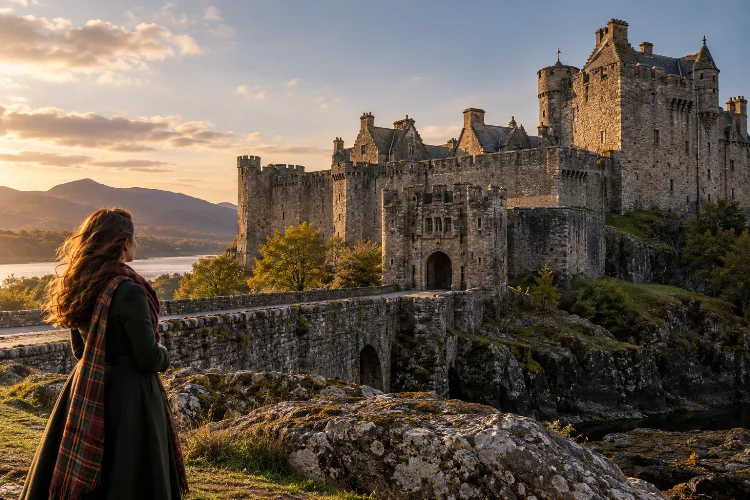
Scotland has no shortage of castles, but the most interesting ones are rarely just collections of towers, walls, and dramatic ruins.
Behind those stones are royal marriages, political rivalries, military campaigns, suspicious deaths, lavish celebrations, and kings who spent almost as much time defending their crowns as wearing them.
That is what makes exploring Scotland’s medieval castles through their royal histories such a rewarding way to travel. Instead of moving from one picturesque fortress to another, you begin to see how individual castles formed part of a much larger network of royal power.
Edinburgh and Stirling were major seats of the monarchy. Linlithgow offered the Stewart court a more comfortable palace between them.
Doune became associated with a man who effectively ruled Scotland without becoming king, while Urquhart shows how royal authority was challenged in the Highlands.
These places also reveal that medieval kingship was surprisingly mobile. Scottish monarchs did not govern permanently from one capital building. They travelled between castles, palaces, hunting estates, parliaments, and military strongholds.
Follow those royal connections and Scotland’s castles suddenly become much more than beautiful ruins.
Why Medieval Castles Were Central to Scottish Royal Power
It is easy to imagine medieval castles mainly as military fortresses.
Defence was certainly important, but royal castles had several jobs at once. They were residences, administrative centres, symbols of authority, storage sites, courts, prisons, and stages where rulers could demonstrate wealth.
Location mattered enormously.
A castle overlooking an important river crossing or trade route could help control an entire region. A fortress near a border might protect royal territory. A residence close to good hunting grounds could serve a completely different purpose while still allowing the monarch to display status.
This helps explain why Edinburgh Castle and Stirling Castle became so politically important.
Both occupied spectacular defensive positions. Historic Environment Scotland describes them as two of Scotland’s principal royal seats during the medieval period.
But Scottish royal life was not fixed in either place.
The royal household moved frequently, taking servants, officials, supplies, documents, and valuable possessions with it. A king might spend part of the year in Edinburgh, travel to Stirling for political business, stop at Linlithgow, then move somewhere else for hunting or military reasons.
Thinking about castles as a connected royal network makes visiting them much more interesting.
Edinburgh Castle: Where Monarchy and Military Power Met
Few castles introduce Scotland’s royal story as dramatically as Edinburgh Castle.
Sitting above the city on Castle Rock, the site had been fortified long before medieval Scotland emerged. Over time, however, it became one of the monarchy’s most important residences.
Its royal associations stretch back roughly a thousand years, and the castle was one of Scotland’s leading royal residences during the 1400s and 1500s.
One of its oldest surviving structures is St Margaret’s Chapel.
David I had the small chapel built around 1130 in memory of his mother, Queen Margaret, later Saint Margaret of Scotland. The building survives while many larger medieval structures around it disappeared or were replaced.
That contrast tells you something important about castles: what visitors see today is usually the result of centuries of rebuilding.
The Stewart Kings Transform Edinburgh
The later Stewart monarchs left an especially strong mark on the castle.
James IV helped shape Crown Square and had the Great Hall completed around 1510. The hall was not simply an impressive room; spaces like this allowed monarchs to host banquets, receive important visitors, conduct ceremonies, and perform kingship in front of the political elite.
Royal apartments occupied another side of Crown Square.
Mary Queen of Scots gave birth there to James VI in 1566. That child would eventually become one of the most important monarchs in British history.
James became King of Scots while still an infant and, in 1603, inherited the English crown as James I following the death of Elizabeth I.
His departure for London changed the role of many Scottish royal residences.
The monarchy had not disappeared from Scotland, but the royal court was now usually based hundreds of miles away.
Don’t Skip the Crown Jewels
For visitors interested in royal history, the Honours of Scotland are particularly significant.
They are Britain’s oldest surviving Crown jewels and include the Crown, Sceptre, and Sword of State. The Stone of Destiny is also displayed within the castle complex.
Give Edinburgh Castle at least two or three hours.
Rather than racing immediately toward the viewpoints, concentrate on Crown Square, the Royal Palace, Great Hall, St Margaret’s Chapel, and the exhibitions explaining the castle’s royal and military evolution.
Once you understand those spaces, the defensive walls make more sense too.
A royal palace was valuable precisely because enemies knew who and what might be inside it.
Stirling Castle: Scotland’s Great Royal Stage
If Edinburgh Castle feels like a fortress that became a palace, Stirling often feels like a palace protected by a fortress.
Its location explains much of its importance.
The castle occupies a volcanic outcrop above the River Forth. For centuries, this position helped control one of the most important routes between the Highlands and Lowlands.
Stirling Castle was first mentioned around 1110. Until the Union of the Crowns in 1603, almost every Scottish monarch either lived there, was crowned there, or died there.
That makes it one of the best places in Scotland for understanding medieval and early Renaissance monarchy.
From Robert the Bruce to the Stewart Court
Stirling was repeatedly contested during the Wars of Scottish Independence.
Major battles unfolded nearby, including William Wallace’s victory at Stirling Bridge in 1297 and Robert the Bruce’s decisive victory over Edward II at Bannockburn in 1314.
After Bannockburn, Bruce ordered Stirling Castle’s defences destroyed so they could not easily be reused by English forces. The castle later returned to military and royal importance.
Several generations later, the Stewart monarchs transformed Stirling into an extraordinary royal residence.
James IV constructed the King’s Old Building in the 1490s and added the Great Hall around 1503. James V later created the Royal Palace, completed around the middle of the 16th century.
The architecture tells its own story.
Scottish monarchs were not living in cultural isolation. They were connected through marriages, diplomacy, art, religion, and politics to powerful European courts.
James V’s palace, in particular, reflects that desire to present the Scottish monarchy as sophisticated and internationally connected.
Mary Queen of Scots at Stirling
Mary Queen of Scots was crowned at Stirling Castle in 1543 when she was still a baby.
She later spent part of her childhood there.
In 1566, her son James was baptised at Stirling during elaborate celebrations. Historic Environment Scotland notes that the festivities ended with the first recorded fireworks display in Scotland.
When visiting, allow enough time for the Royal Palace, Great Hall, kitchens, and ramparts.
Stirling is one of those castles where spending an extra hour makes a huge difference because the domestic spaces explain royal life much better than the defensive walls alone.
Linlithgow Palace: Where the Royals Came to Breathe
Linlithgow Palace is technically a palace rather than a castle, but leaving it out of Scotland’s medieval royal story would make little sense.
It filled a crucial role within the royal network.
Located between Edinburgh and Stirling, Linlithgow offered the monarchy a comfortable stopping point between its two major castles.
James I ordered construction of the present palace after a fire damaged the earlier royal residence in 1424. What followed was gradually developed into an elegant Stewart pleasure palace.
Compared with Edinburgh or Stirling, Linlithgow had a calmer purpose.
There was still political symbolism everywhere, but this was somewhere the royal family could enjoy a less militarised environment.
The palace overlooks Linlithgow Loch, and even in its ruined condition it is easy to understand why members of the court enjoyed staying there.
Birthplace of Kings and Queens
Linlithgow became particularly important as a royal nursery.
James V was born there in 1512. His daughter, Mary Queen of Scots, was born there in December 1542, while Princess Elizabeth, daughter of James VI, was born at the palace in 1596.
That gives the palace a more personal royal history than many fortresses.
You are not simply standing where monarchs planned wars or imprisoned opponents. You are also visiting a place connected with childhood, family life, celebrations, and the everyday movement of the royal household.
Linlithgow declined rapidly after James VI moved his main court to London in 1603.
Its surviving roofless walls now create one of Scotland’s most atmospheric royal ruins.
If you are travelling between Edinburgh and Stirling, it is almost perfectly positioned for a stop.
Rather than visiting all three in a single exhausting day, stay nearby or spread the route across two days. Good accomodation is available throughout the central belt, making this royal triangle easy to explore without rushing.
Doune Castle and Scotland’s Almost-King
Doune Castle introduces a different kind of royal story.
It was associated with Robert Stewart, Duke of Albany, the younger brother of King Robert III.
Albany acquired Doune in 1361 through his marriage to Margaret Graham, Countess of Menteith. The impressive castle seen today largely reflects his ambitions.
Robert III was politically weak and had suffered serious physical injuries.
As a result, Albany gradually became one of the most powerful figures in Scotland.
From 1386 until his death in 1420, apart from a short interruption, he effectively governed the kingdom. When the future James I was captured in England in 1406, Albany became Governor and Guardian of Scotland.
He never officially became king.
Yet his political position was so dominant that Historic Environment Scotland describes him as Scotland’s “uncrowned king.”
From Noble Fortress to Royal Castle
After Albany’s death, his son Murdoch inherited his political position.
Things changed dramatically when James I returned from English captivity.
Murdoch was executed in 1425, and Doune became part of the royal estate. The castle was subsequently used as a royal retreat, hunting lodge, and dower house associated with Scottish queens.
Doune is smaller than Stirling or Edinburgh, which can actually make it easier to understand.
The great hall, lord’s hall, courtyard, kitchens, and residential spaces sit close together.
You can imagine political power operating at a much more intimate scale.
That is useful because medieval monarchy was not always conducted in gigantic palaces.
Sometimes the most important person in Scotland was living and working from a relatively compact fortified residence.
Urquhart Castle: Royal Authority on the Edge of the Highlands
Urquhart Castle offers a very different experience.
Its ruins overlook Loch Ness, creating one of Scotland’s most photographed castle landscapes.
The location is beautiful, but the history was anything but peaceful.
Edward I of England captured Urquhart during his invasion of Scotland in 1296. The castle subsequently changed hands during the Wars of Independence before coming under Robert the Bruce’s control after he became King of Scots in 1306.
In 1332, Urquhart was reportedly the only Highland castle that continued holding out against English forces.
Later, however, the main challenge to royal authority came from within Scotland.
The Crown Versus the Lords of the Isles
The MacDonald Lords of the Isles controlled extensive territories across western Scotland.
Their growing power frequently brought them into conflict with the Crown.
Urquhart became caught between these competing political worlds. The MacDonalds repeatedly seized the castle as they attempted to extend their influence farther east.
The struggle lasted for generations.
James IV eventually granted the barony of Urquhart to the Grant family in 1509 and instructed them to restore the fortress and estate.
This history is useful because it challenges the idea that medieval Scotland was simply a kingdom controlled neatly from Edinburgh.
Royal power became weaker as distance increased.
Highland lords and regional families could command enormous influence, and castles such as Urquhart functioned as practical tools for extending royal authority into contested territory.
Today, the ruined Grant Tower provides superb views over Loch Ness.
Spend time looking inland as well as across the water. Understanding the surrounding glens helps explain why controlling this particular location mattered.
Blackness and Dundonald: Two Different Faces of Royal Castle Life
Not every royal castle became a grand palace.
Blackness Castle demonstrates what happened when a noble residence evolved into a state fortress.
Built in the 15th century for the powerful Crichton family, Blackness soon became a royal property. Its position beside the Firth of Forth gave it strategic value close to Linlithgow.
During the reign of James V, major work transformed Blackness into an artillery fortress and state prison.
The castle’s unusual shape earned it the nickname “the ship that never sailed.”
For travellers following the Edinburgh–Linlithgow–Stirling royal corridor, Blackness makes an excellent detour.
It reveals the harder side of monarchy: imprisonment, defence, artillery, and state control.
Dundonald and the Birth of the Stewart Dynasty
Dundonald Castle tells another story entirely.
The surviving stone castle was built around 1371 for Robert II, grandson of Robert the Bruce and the first king of the Stewart dynasty.
Robert built it shortly after becoming king and died there in 1390.
Compared with Stirling, Dundonald feels modest.
That is exactly why it is worth visiting.
You can see how royal residences developed before later Stewart monarchs created the enormous ceremonial architecture found at Stirling and Linlithgow.
Visiting the castles seperately also shows how dramatically royal expectations changed between the 14th and 16th centuries.
By James V’s reign, monarchy demanded much more elaborate architectural theatre.
Following Mary Queen of Scots Across Scotland
Few historical figures connect Scotland’s castles as effectively as Mary Queen of Scots.
She was born at Linlithgow Palace in 1542, crowned at Stirling Castle as an infant, lived there during childhood, later occupied Edinburgh Castle, and gave birth to the future James VI inside Edinburgh’s Royal Palace.
Her movements extended much farther.
Craigmillar Castle near Edinburgh became one of her retreats. Crichton Castle was associated with James Hepburn, Earl of Bothwell, who became Mary’s third husband. She also visited Edzell Castle in 1562.
Following Mary’s story is a useful way to create a themed castle itinerary.
Instead of selecting sites only because they are visually impressive, you can trace a single royal life across Scotland.
That turns separate ruins into chapters of the same story.
It also reveals how quickly political fortune could change.
Mary began life as a queen, spent much of her childhood in royal security, returned to Scotland as a young widow, faced rebellion, abdicated in 1567, and eventually fled to England.
Castle walls offered protection, but medieval and Renaissance royalty was never particularly secure.
How to Plan a Royal Castle Road Trip
The easiest route begins in central Scotland.
Start with Edinburgh Castle, where you can spend half a day exploring royal apartments, Crown Square, the Great Hall, and the Honours of Scotland.
On the second day, travel west to Linlithgow Palace.
Blackness Castle can be added if you have enough time, especially if you want to understand the military side of royal government.
Continue toward Stirling and give the castle several hours rather than squeezing it into the end of the day.
Doune lies only a short journey farther north and works naturally as the next stop.
From there, travellers with more time can continue through the Highlands toward Loch Ness and Urquhart Castle.
That turns a central Scotland castle break into a broader journey showing how the monarchy attempted to exercise authority across very different regions.
Check opening arrangements before travelling.
Historic buildings sometimes have areas closed for conservation, structural inspections, weather, or maintenance.
Booking ahead is especially neccessary for highly visited attractions such as Edinburgh Castle, where Historic Environment Scotland advises advance ticket booking to guarantee entry.
Avoid trying to visit three major castles every day.
After a while, stone staircases and great halls begin blending together.
Two substantial sites in a day is usually plenty.
Spend time reading the interpretation, looking at architectural details, and connecting each monarch to the places you have already visited.
That is how a castle road trip becomes a historical journey rather than a checklist.
Look Beyond Battles and Ghost Stories
Scottish castle tourism often focuses heavily on battles, sieges, executions, and ghost stories.
Those stories are entertaining, but they represent only part of medieval royal life.
Pay attention to kitchens, fireplaces, windows, chapels, courtyards, bedrooms, and great halls.
Ask practical questions.
Where did hundreds of servants sleep? How was food transported? How did a queen keep warm during winter? Where did visiting nobles wait before meeting the king?
A castle was a working household as well as a political machine.
The size of a hall tells you something about hospitality and hierarchy. A chapel reveals the central role of religion. Decorative façades show how rulers wanted visitors to perceive them.
Even the landscape matters.
Stirling’s position explains military strategy. Edinburgh’s rock communicates security. Linlithgow’s lakeside setting makes sense as a comfortable royal retreat.
Look at the enviroment surrounding each site rather than focusing only on the building.
Often, the landscape explains why the castle exists in the first place.
Exploring Scotland’s medieval castles through their royal histories transforms a castle trip into something much richer.
Edinburgh reveals the close relationship between royal ceremony and military security. Stirling shows the Stewart monarchy at its most ambitious, while Linlithgow provides a glimpse into the more personal world of royal family life.
Doune tells the story of power without a crown, and Urquhart shows how difficult royal authority could be to maintain in the Highlands.
The best way to explore these places is slowly.
Choose a handful of castles, learn which monarchs connected them, and follow those stories across the landscape. Start with the royal triangle of Edinburgh, Linlithgow, and Stirling, then extend the journey toward Doune or the Highlands.
Scotland’s castles become far more memorable when you stop seeing them as ruins and start seeing them as places where a kingdom was actually governed.