
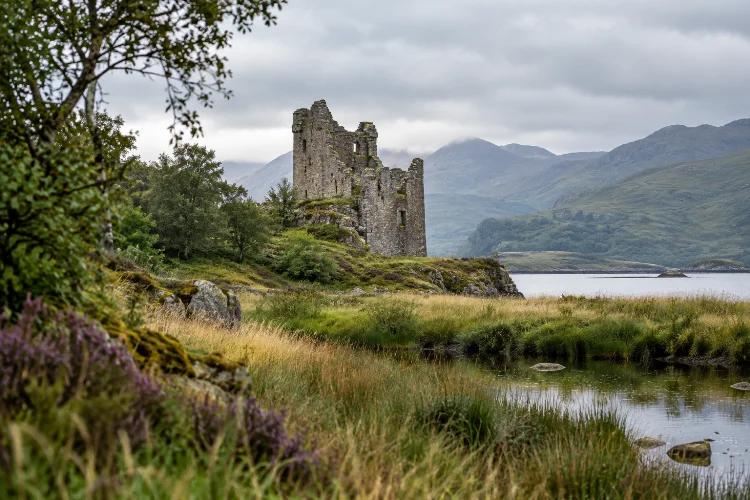
Mention castles in Scotland and a familiar list usually appears: Edinburgh, Stirling, Eilean Donan, Balmoral, and perhaps Urquhart overlooking Loch Ness.
They are famous for good reasons. They are dramatic, historically important, and extremely photogenic. But Scotland’s castle story becomes much more interesting once you move beyond the landmarks appearing on almost every first-time itinerary.
Discovering lesser-known Scottish castles beyond famous landmarks can lead you to medieval tower houses hidden near cities, ruined fortresses surrounded by gardens, triangular castles beside wetlands, and noble residences connected with political plots that helped shape Scotland.
Places such as Craigmillar, Dirleton, Bothwell, Castle Campbell, Aberdour, Huntingtower, and Newark generally receive less international attention than Scotland’s headline attractions, yet many preserve remarkable architecture and surprisingly complicated histories.
There is another advantage: exploring quieter historic sites often gives you more time to actually understand them.
Instead of moving through crowded rooms at the same pace as everyone else, you can wander through courtyards, inspect old defensive walls, and imagine the people who once lived there.
That slower experience is where Scotland’s overlooked castles really shine.
Why Look Beyond Scotland’s Famous Castles?
The biggest Scottish castles tend to tell stories about kings, queens, national wars, and dramatic sieges.
Smaller castles often bring history much closer to everyday life.
They show how noble families lived, how tower houses expanded as wealth increased, how kitchens and private chambers were arranged, and how military architecture gradually became less important than comfort and social display.
This variety matters because there was never one standard “Scottish castle.”
Some began as simple fortified residences before generations of owners added halls, courtyards, gardens, chapels, and decorative apartments. Others remained heavily defensive because they occupied politically unstable regions.
Location also changes the experience.
An urban castle such as Craigmillar gives you an entirely different impression from Caerlaverock, where a water-filled moat and open countryside create something closer to the classic medieval fortress people imagine from childhood.
Visiting lesser-known sites can make a road trip more manageable too.
You can combine them with villages, coastlines, woodland walks, historic towns, and local museums rather than spending every day travelling between Scotland’s biggest tourism centres.
The best strategy is not to avoid famous landmarks completely.
Instead, use them as an introduction, then explore the smaller places that fill in the gaps.
Craigmillar Castle: Edinburgh’s Other Great Fortress
You do not need to travel deep into the Highlands to escape the crowds around Scotland’s most famous castle.
Craigmillar Castle sits on the outskirts of Edinburgh and offers one of the easiest opportunities to experience a substantial medieval fortress without the atmosphere of the Royal Mile.
The core of Craigmillar dates from the late 1300s. Its tower house rises about 17 metres to the battlements and has walls approaching three metres thick in places.
Later generations expanded the original structure into a much larger complex of courtyards, residential buildings, defensive walls, and gardens.
The result is wonderfully confusing.
There are staircases, chambers, narrow passages, roofless rooms, defensive walls, and corners where you suddenly discover another part of the castle.
That makes Craigmillar particularly fun if you prefer exploring to simply looking at furnished rooms.
A Castle Closely Linked to Mary Queen of Scots
Craigmillar’s best-known historical association is with Mary Queen of Scots.
Mary stayed at the castle in 1566 while recovering after illness following the birth of her son, the future James VI. The castle’s owner, Sir Simon Preston, had been a supporter of the queen, although he later became involved in holding her prisoner after her capture in 1567.
That connection makes Craigmillar an excellent addition to a Mary Queen of Scots itinerary.
You could visit Edinburgh Castle and Holyrood Palace for the major royal story, then come here to see a much quieter place associated with the same political world.
There are currently restrictions on part of Craigmillar’s rooftop walkway while conservation work is carried out, so checking current access information before visiting is sensible.
Even with restrictions, the castle remains one of the strongest candidates for anyone searching for underrated castles near Edinburgh.
Dirleton Castle: Medieval Ruins Wrapped in Beautiful Gardens
East Lothian is often visited for beaches, golf, and coastal towns such as North Berwick.
Hidden within that itinerary is Dirleton Castle.
Dirleton is one of Scotland’s oldest surviving strongholds, and its story stretches across roughly four centuries of noble occupation. The de Vaux, Haliburton, and Ruthven families all shaped the castle before warfare and changing fashions eventually ended its life as a noble residence.
Some of the oldest surviving structures date from the 1200s.
The de Vaux towers are particularly important because they represent unusually early castle architecture in Scotland. Historic Environment Scotland notes similarities between Dirleton’s design and a castle near Amiens in northern France, reflecting wider European architectural connections.
The castle also became caught up in the Wars of Scottish Independence.
Forces acting for Edward I captured Dirleton in 1298, and the stronghold changed hands more than once during the conflict. Later owners rebuilt damaged sections and created new residential spaces.
Come for the Fortress, Stay for the Gardens
Dirleton feels unusually relaxed for a castle with such a violent history.
Its ruins sit beside formal gardens that became part of the property’s later designed landscape. The current gardens include plantings developed during the Victorian and Arts and Crafts periods.
This combination makes Dirleton a strong choice for travellers who are not obsessed with military history.
One person can examine medieval vaults and defensive architecture while someone else spends more time wandering through gardens.
It also pairs naturally with North Berwick and the East Lothian coast.
Rather than rushing back to Edinburgh after visiting the castle, spend the rest of the day along the coast. This is the kind of slower combination that turns a historical stop into a much better travel day.
Castle Campbell: A Fortress Hidden Above Dollar
Castle Campbell has one of the most atmospheric settings of any lesser-known castle in central Scotland.
The castle stands above the town of Dollar on a narrow ridge surrounded by the Ochil Hills. Deep ravines fall away on either side, carrying streams with wonderfully dramatic names: the Burn of Care and the Burn of Sorrow.
It sounds almost too perfectly Scottish.
Originally called Castle Glume, the fortress dates from the early 1400s. It later passed to Colin Campbell, 1st Earl of Argyll, and was renamed Castle Campbell in 1489. The Campbells then used it as an important Lowland residence for close to two centuries.
Its location made political sense.
The powerful Campbell family was strongly associated with western Scotland, but maintaining a residence close to Stirling and Scotland’s central royal world allowed them to remain connected to national politics.
The castle itself also reflects their increasing status.
Its tower rises around 20 metres and was accompanied by residential ranges containing a great hall, private chamber, kitchen, and storage areas. Historic Environment Scotland notes similarities between parts of Castle Campbell and royal buildings at Stirling Castle.
Make the Walk Part of the Visit
Castle Campbell is one of those places where the surrounding landscape matters almost as much as the building.
Rather than treating the castle as an isolated attraction, allow time to explore the wooded paths and glens around Dollar.
The castle’s position becomes much more impressive when you approach it through the surrounding terrain.
Historical visitors included Mary Queen of Scots in 1563 and Protestant reformer John Knox in 1556. The castle later suffered during the political and military conflicts of the 17th century.
For travellers based around Stirling, Castle Campbell offers an easy way to add a completely different style of stronghold without driving across half of Scotland.
Bothwell Castle: A Giant Medieval Project That Was Never Finished
Bothwell Castle sits beside a bend in the River Clyde and looks like the remains of an ambitious building project suddenly interrupted by history.
That is basically what happened.
Construction began on a grand scale in the late 1200s, but warfare repeatedly disrupted the project. During the Wars of Scottish Independence, the castle moved between English and Scottish control, and Edward I mounted a major siege against it in 1301.
The original plans were never fully completed.
Yet what survives is still substantial.
The most striking feature is the enormous circular donjon, or keep. Historic Environment Scotland describes it as being without parallel in Scotland, making Bothwell particularly useful for visitors interested in medieval defensive design.
Later additions include a 14th-century chapel associated with the powerful Black Douglas family.
What makes Bothwell especially appealing is how little effort is required to reach such significant medieval architecture.
It can be incorporated into a trip around Glasgow or the Clyde Valley, making it a useful alternative for travellers who have limited time but still want to see something beyond the best-known Scottish monuments.
Allow time to walk around the exterior.
The relationship between the castle and the River Clyde is part of what made the position strategically valuable, and seeing the landscape helps the defensive architecture make more sense.
Caerlaverock Castle: Scotland’s Triangular Surprise
Caerlaverock is arguably the least “hidden” castle on this list among serious history fans, but international visitors still often skip it because of its location in southwest Scotland.
That is a mistake.
Caerlaverock has something instantly memorable: it is triangular.
Historic Environment Scotland describes its triangular plan as unique among British castles. Three defensive walls connect high corner towers, while an imposing twin-towered gatehouse guards the northern side.
Then there is the moat.
Water still surrounds the castle, creating the sort of medieval silhouette that looks almost suspiciously perfect in photographs.
The Maxwell family controlled Caerlaverock for centuries and repeatedly rebuilt or improved it. The castle experienced numerous attacks because of its position near the Anglo-Scottish border.
One of the best-documented episodes occurred in 1300.
Edward I arrived with an English army and besieged the relatively small garrison. The defenders surrendered after only a couple of days, but contemporary records of the campaign provide unusually detailed evidence about medieval siege warfare.
Another major siege followed in 1640, when the Maxwell family’s support for Charles I brought Caerlaverock into conflict with Covenanter forces. The defenders held out for around 13 weeks before surrendering. Parts of the castle were then demolished to prevent further military use.
Don’t Leave After Photographing the Moat
Many visitors understandably spend most of their time admiring the triangular castle itself.
But the surrounding landscape deserves attention.
The castle grounds contain a mix of habitats, and the nearby Caerlaverock National Nature Reserve makes it possible to combine history and wildlife in one day.
There are currently some conservation-related access restrictions within the castle, so check the official visitor page before travelling.
Dumfries makes a convenient base if you want to explore more of southwest Scotland rather than treating Caerlaverock as a long day trip from the central belt.
Aberdour Castle: Watch 500 Years of Architecture in One Place
Aberdour Castle in Fife is particularly interesting because you can almost read its architectural development while walking through it.
The complex contains building phases spanning centuries.
Historic Environment Scotland considers Aberdour one of the oldest surviving masonry castles in Scotland. The earliest hall-house may date to the early or mid-1100s, while subsequent owners repeatedly expanded and transformed the residence.
That makes it less visually uniform than a textbook fortress.
It is also far more educational.
You can see how a relatively early medieval residence gradually developed into something larger, more comfortable, and increasingly focused on noble lifestyle rather than pure defence.
Robert the Bruce granted Aberdour to his nephew Thomas Randolph, Earl of Moray, in 1325. It later passed to the Douglas family, whose descendants continued modifying the property over generations.
One important resident was James Douglas, 4th Earl of Morton, who became Regent of Scotland during the minority of James VI.
Gardens Make Aberdour Feel Different
The castle is accompanied by terraced gardens, a walled garden, orchard, and dovecot.
That makes Aberdour feel less like a ruined military site and more like a record of changing noble lifestyles.
It is particularly good for visitors interested in architecture because the complex shows the gradual shift from defensive medieval building toward more comfortable domestic design.
Its Fife location also makes it easy to combine with coastal villages.
Instead of visiting Aberdour seperately as a single attraction, build it into a full day that includes the surrounding coastline or another historic town.
Huntingtower Castle: Political Intrigue Near Perth
Huntingtower Castle does not have a dramatic clifftop location or enormous curtain walls.
Its attraction is stranger.
The building was originally formed from two tower houses standing only about three metres apart. The reason for this unusual arrangement remains uncertain.
Before 1600, Huntingtower was known as the Place of Ruthven.
The Ruthven family became deeply involved in royal politics, and the castle witnessed one of the more extraordinary episodes in the reign of James VI.
In 1582, during the event known as the Ruthven Raid, the young king was effectively held against his will by the Earl of Gowrie and his allies. James remained under their control for around ten months.
The relationship between king and Ruthvens never fully recovered.
Following the mysterious Gowrie Conspiracy in 1600, members of the family were accused of plotting against James. Their estates were forfeited and the Place of Ruthven was renamed Huntingtower.
Mary Queen of Scots also stayed here in 1565 with Lord Darnley.
Inside, look for surviving decorative details rather than expecting huge halls. Huntingtower preserves one of Scotland’s oldest painted ceilings as well as fragments of wall painting.
Because the castle sits close to Perth, it is particularly easy to include on a broader central Scotland road trip.
Newark Castle: Renaissance Elegance Beside the Clyde
Port Glasgow is probably not the first place most travellers imagine when planning a Scottish castle holiday.
That is exactly why Newark Castle is interesting.
For years, the building was visually overshadowed by the industrial landscape and enormous shipyards of the Clyde. As that industrial environment changed, the castle became much more visible within the townscape.
The Maxwell family began developing the site in the late 1400s.
The oldest surviving parts include a tower house and gatehouse, while later generations transformed the complex into a sophisticated Renaissance residence.
Sir Patrick Maxwell carried out major rebuilding during the late 1500s, creating a residence with decorative windows, gables, turrets, and architectural details very different from the severe appearance of earlier medieval fortresses.
That contrast is what makes Newark valuable.
Visit Bothwell and Newark on the same broader trip and you see two very different ideas of what a castle could be.
One is dominated by medieval military architecture.
The other demonstrates how elite residences increasingly prioritised comfort, presentation, and Renaissance fashion.
James IV even stayed at Newark in 1495 before sailing toward the Hebrides as part of efforts to strengthen royal authority there.
Newark is not remotely positioned, but that is part of the appeal.
It shows that fascinating Scottish castles are sometimes hidden by familiarity rather than geography.
How to Build a Lesser-Known Scottish Castle Road Trip
Trying to visit all these castles in one journey would create a lot of unnecessary driving.
A better approach is regional.
Around Edinburgh, combine Craigmillar with Dirleton. Add Aberdour if you have another day and want to cross into Fife.
Around Stirling and Perth, Castle Campbell and Huntingtower work well as quieter alternatives to the huge royal attractions.
Glasgow travellers can explore Bothwell and Newark without committing to a major cross-country road trip.
Caerlaverock deserves its own southwest Scotland itinerary.
Stay around Dumfries and combine the castle with local countryside, coastline, nature reserves, and other historic sites rather than immediately driving north again.
This regional approach also keeps the trip casual.
You have time for lunch in a village, a spontaneous coastal walk, or an extra hour exploring a castle instead of constantly watching the clock.
Check Access Before You Travel
Historic buildings need constant conservation.
Sections of castles can close temporarily because of masonry inspections, restoration, storms, or safety work. Craigmillar and Caerlaverock, for example, currently have some visitor access restrictions related to conservation.
Opening days also vary seasonally at some smaller properties.
Check the official site shortly before travelling rather than trusting an old blog or saved itinerary.
Booking accomodation near the area you are exploring can also make a surprising difference.
A relaxed two-night stay around Fife or Perthshire usually creates a more enjoyable castle trip than driving back to Edinburgh or Glasgow every evening.
How to Get More From a Quiet Castle Visit
The great advantage of an overlooked castle is time.
Use it.
Do not immediately walk toward the tallest tower.
Start outside and look at the landscape. Ask why the castle was positioned there. Is there a river, ravine, coastline, trade route, or naturally defensive hill?
Then look at how the building changed.
Older masonry may belong to a defensive tower, while larger windows and decorative façades often indicate later periods when comfort and status became increasingly important.
Spend time in kitchens and storage areas too.
They tell you how these enormous households actually functioned.
The glamorous great hall only worked because servants were storing food, managing fires, preparing meals, carrying water, caring for horses, and completing dozens of less glamorous tasks elsewhere.
And do not worry if you cannot remember every historical date.
Choose one story from each castle.
Remember Mary Queen of Scots at Craigmillar, Edward I’s siege of Caerlaverock, the Ruthven Raid at Huntingtower, or the Campbells above Dollar.
Those human stories are much easier to carry with you than a long timeline.
Discovering lesser-known Scottish castles beyond famous landmarks reveals a side of Scotland that many rushed itineraries completely miss.
Craigmillar offers medieval complexity within reach of Edinburgh. Dirleton combines ancient fortifications with elegant gardens, while Castle Campbell hides dramatically above Dollar.
Bothwell preserves extraordinary medieval architecture, Caerlaverock delivers one of Britain’s most unusual castle designs, and Aberdour shows how noble residences evolved over centuries.
Huntingtower and Newark prove that fascinating history can also be found beside modern towns rather than remote Highland roads.
The best approach is simple: choose one region, slow the itinerary down, and give each castle enough time to tell its story.
On your next Scotland trip, visit the famous fortress if you want—but leave at least one day for the castle you had never heard of before. It may end up being the one you remember most.