
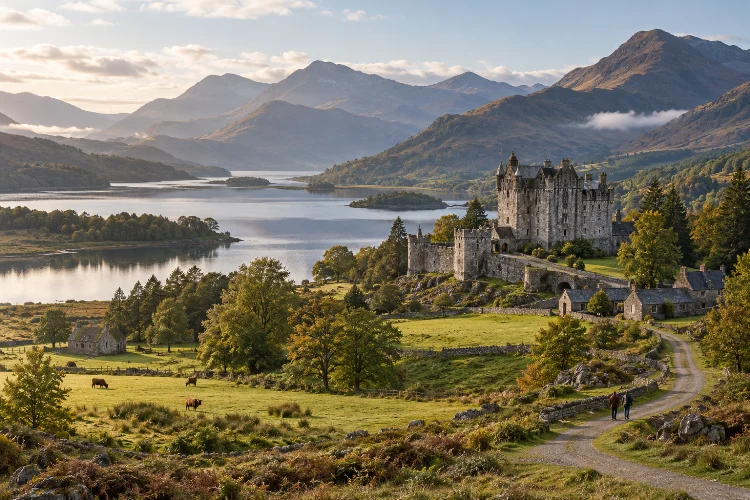
A Highland castle makes much more sense when you stop looking at the building and start looking at the land around it.
The loch, grazing fields, forests, villages, old roads, and mountains were not simply attractive scenery. Together, they formed estates that supported powerful families, tenants, warriors, servants, farmers, and communities for generations.
That makes tracing Scotland’s clan history through Highland castle estates one of the most interesting ways to explore the country.
Instead of treating clans as a collection of tartans and surnames, you can see how land ownership, loyalty, marriage, warfare, royal politics, and eventually economic change shaped Highland society.
Clan MacLeod at Dunvegan, the Campbells at Inveraray, the Mackenzies at Castle Leod, Clan Donald at Armadale, and the Sutherland family at Dunrobin each tell very different stories.
Some estates remain family homes. Others became museums or heritage landscapes. Many also carry difficult histories connected with Jacobitism, forfeiture, agricultural change, and the Highland Clearances.
Explore them together and Scottish clan history becomes less like legend and much more like a complicated human story written across the landscape.
Understanding the Clan System Before Visiting the Castles
Popular culture often presents a Scottish clan as one enormous family in matching tartan.
Reality was more complicated.
The Gaelic word clann relates to children or descendants, but membership did not necessarily mean everyone shared close blood relationships.
People could attach themselves to a powerful clan for protection, political identity, access to land, or local loyalty. VisitScotland notes that surnames could also be adopted as territories changed hands.
Clan chiefs were therefore more than symbolic family leaders.
They controlled territory, formed alliances, managed estates, settled disputes, collected rents, and could call on followers during periods of warfare.
Historic Environment Scotland describes clans as social and political groups built around kinship and local loyalties whose strongholds helped define the Scottish landscape.
This is why castle estates are so useful for understanding Highland history.
The castle represented authority, but the surrounding estate made that authority possible.
Farms provided food. Cattle represented wealth. Woodland supplied timber and fuel. Rivers supported fishing, while roads and passes connected communities with markets and neighbouring territories.
When you visit a Highland castle, spend as much time thinking about the surrounding geography as the stone walls.
Often, the landscape explains the clan better than the family tree does.
Dunvegan Castle: Eight Centuries of Clan MacLeod
Dunvegan Castle on the Isle of Skye is one of the clearest places to see continuity between a clan, its chief, and its traditional territory.
The castle has been the ancestral home of the Chiefs of Clan MacLeod for around 800 years. The estate describes Dunvegan as Scotland’s oldest continuously inhabited castle and notes that it remains the family home of the clan chief.
That continuity is remarkable.
The building itself is not frozen in one medieval period. Dunvegan contains elements from roughly ten different phases of construction stretching from around 1200 into the 19th century. Its current appearance was heavily influenced by Victorian remodelling, but much older structures remain underneath.
That architectural layering is exactly what makes historic estates interesting.
Successful families rarely left their castles unchanged. They expanded them, modernised rooms, improved defences, added gardens, and adapted to changing ideas about comfort.
The MacLeods and the Landscape of Skye
Clan MacLeod’s history is closely connected with the wider Hebrides.
According to Dunvegan’s clan history, the clan descends from Leod, who lived during the 13th century when control of the Hebrides was shifting from Norse to Scottish authority. His lands included territories on Skye as well as Lewis, Harris, and Glenelg.
This Norse-Gaelic background is worth remembering when exploring the islands.
Highland clan history was never completely isolated from the rest of Europe. Western Scotland was connected by sea to Ireland, Scandinavia, the Isle of Man, and other islands.
The ocean was often a highway rather than a barrier.
At Dunvegan, the estate therefore matters as much as the castle collection. Gardens, shoreline, surrounding hills, and Loch Dunvegan help explain why this position remained significant for centuries.
The clan’s famous Fairy Flag adds another layer, combining documented heritage with clan legend.
You do not need to believe every traditional story literally to appreciate its importance.
Legends helped communities explain identity, loyalty, and continuity long before history was packaged into museums.
Inveraray Castle: Clan Campbell and Political Power
If Dunvegan represents long-term island continuity, Inveraray demonstrates how a Highland clan could become deeply involved in national politics.
Inveraray Castle is the seat of the Duke of Argyll and the chief of Clan Campbell. The family describes the castle as both a private family home and a place reflecting generations of Campbell involvement in Scottish and British history.
The Campbells became one of Scotland’s most influential families.
Their rise was connected to strategic marriages, royal service, territorial expansion, and political alliances.
The official Campbell timeline records the family’s support for Robert the Bruce during the Wars of Scottish Independence, after which Campbells received additional influence and connections to the royal family.
Over time, Campbell territory spread across large parts of western Scotland.
This expansion was not always peaceful.
Clan politics involved rivalry, shifting loyalties, land disputes, and violent confrontation. Relationships with families such as the MacDonalds could become particularly bitter.
But reducing the Campbells to clan warfare misses half the story.
Their chiefs also operated within parliament, royal government, aristocratic society, military service, and eventually the politics of Britain.
Why Inveraray Feels Different From an Older Highland Stronghold
The present Inveraray Castle looks more like a grand aristocratic residence than a rough medieval fortress.
That difference tells you how clan leadership changed.
By the 18th and 19th centuries, leading Highland families increasingly lived like major British landowners. Formal gardens, art collections, landscaped estates, ceremonial rooms, and architectural fashion mattered alongside traditional clan identity.
The surrounding Inveraray landscape is equally important.
Loch Fyne, woodland, estate grounds, and the planned town all show how aristocratic landownership could shape an entire area rather than simply one building.
Spend time in the town after visiting the castle.
Seeing them together makes it easier to understand an estate as an economic and social system instead of an isolated tourist attraction.
Castle Leod: Clan Mackenzie, Jacobitism, and Survival
Castle Leod near Strathpeffer offers a more intimate version of the living clan estate.
It remains home to John Mackenzie, 5th Earl of Cromartie and chief of Clan Mackenzie. The family says Mackenzies have lived at Castle Leod for more than 500 years, and the property remains an important gathering point for clan members from around the world.
The Mackenzies became one of the most powerful Highland families.
Their earlier territorial centre was connected with Kintail and Eilean Donan, while their influence eventually expanded across extensive areas of the northwestern Highlands.
Castle Leod reflects that growth.
By the 15th century, much of the historic castle was already taking shape, with a substantial tower, gun loops, decorative stonework, and defensive features.
Yet the family’s history also illustrates how quickly political choices could threaten an estate.
When Clan Politics Became National Politics
Several generations of Mackenzies became involved in the great political arguments of the 17th and 18th centuries.
The family’s official history records both support for the 1707 Union and later opposition to the Hanoverian government.
George Mackenzie, 3rd Earl of Cromartie, joined the Jacobite Rising and was captured after the failure of the rebellion. His title and property were forfeited, while his death sentence was eventually commuted.
Later generations recovered the estate.
That sequence – power, rebellion, forfeiture, exile, and restoration—appears repeatedly across Highland history.
Castle Leod survived it all.
Today it remains a family home rather than a conventional mass-tourism attraction and opens to visitors on a limited number of days each year.
That makes advance planning neccessary, but it also gives the estate a particularly strong sense of living history.
You are not entering a reconstructed idea of clan heritage.
You are visiting a place still connected to the family whose story shaped it.
Armadale Castle: Understanding the Rise and Fall of Clan Donald
Few clans had ambitions on the scale of Clan Donald.
For centuries, the Lords of the Isles controlled a maritime territory stretching across western Scotland and the Hebrides. Their political power was substantial enough to challenge the Scottish Crown.
Clan Donald traces its name to Donald, a descendant of the 12th-century ruler Somerled. From this lineage emerged the Lords of the Isles, whose centre of authority was at Finlaggan on Islay.
Their power depended heavily on the sea.
This is essential to understanding western Highland history.
Looking at a modern road map makes islands such as Skye, Islay, Mull, and the Outer Hebrides seem seperated by water. Historically, boats connected these territories far more naturally than difficult journeys across mountains.
The Lordship effectively functioned as a sea-based political world.
That independence eventually worried Scottish monarchs.
In 1493, James IV forfeited the Lordship of the Isles, bringing its semi-independent political authority to an end. Clan Donald itself, however, did not disappear. Numerous branches – including Clanranald, Glengarry, Glencoe, Keppoch, Sleat, and others – continued to shape Highland history.
Armadale as a Museum of Clan Transformation
Armadale Castle on Skye is especially useful because it does not pretend clan history ended with medieval warriors.
The estate covers roughly 20,000 acres and includes the Museum of the Isles, which places Clan Donald within around 1,500 years of Highland history. Its interpretation follows the clan from the Lords of the Isles through Jacobite conflict, clearance, crofting, and emigration.
That wider timeline matters.
Many descendants of Highland clans now live in Canada, the United States, Australia, New Zealand, and elsewhere partly because major economic and demographic changes pushed generations away from their traditional homelands.
At Armadale, the castle ruins are only one piece of the story.
The gardens, estate landscape, museum objects, and views across the Sound of Sleat provide a much fuller picture.
Give yourself a few hours instead of photographing the ruins and immediately leaving Skye.
Cawdor Castle: How a Fortress Becomes a Family Estate
Cawdor offers another good example of long-term adaptation.
The castle’s core dates from the late 14th century and developed around a substantial medieval tower house. The property has remained associated with the Cawdor family for more than 600 years.
One of its best-known stories concerns the tree preserved beneath the old tower.
Legend says a Thane of Cawdor followed a dream instructing him to let a donkey choose the location of his new fortress. The animal supposedly rested beneath a tree, and the castle was built around it.
Scientific analysis later identified the surviving wood as holly and dated it to around 1372.
It is a perfect Scottish castle story: part folklore, part archaeology.
Cawdor is also frequently associated in popular culture with Shakespeare’s Macbeth, although the historical Macbeth lived centuries before the surviving castle was constructed.
That is a useful reminder not to treat literary tradition as architectural evidence.
Look Beyond the Tower
The most revealing part of Cawdor may be how far the estate eventually moved beyond defence.
Three major gardens developed over generations, while the surrounding Big Wood preserves ancient woodland and walking trails.
This reflects a broader transformation among Highland elites.
A fortified tower built for security gradually became part of a country estate designed around comfort, landscape, collecting, gardening, and leisure.
Visiting the rooms and then walking through the grounds helps you see that transition clearly.
Dunrobin Castle and the Difficult Legacy of Highland Estates
Dunrobin Castle is visually very different from the stereotypical Highland fortress.
Standing above the Moray Firth near Golspie, its conical towers and formal gardens make it resemble a French château.
Yet underneath that appearance is a much older estate.
The property has been associated with the Earls and later Dukes of Sutherland for centuries. The earldom dates to the 13th century, and a stronghold was recorded here by the early 1400s. The modern complex grew around an older fortified keep that still survives within later additions.
Today Dunrobin contains 189 rooms, making it the largest great house in the Northern Highlands. Major 19th-century remodelling by architect Charles Barry gave the building much of its current appearance.
But an estate like Dunrobin should not be understood purely through architecture.
The Highland Clearances Cannot Be Left Out
The story of Highland estates becomes much more difficult during the late 18th and 19th centuries.
Traditional relationships between chiefs, tenants, and land were increasingly transformed by commercial estate management.
Agricultural “improvement,” sheep farming, changing rents, population pressure, and new economic ideas contributed to the displacement of communities across parts of the Highlands.
Historic Environment Scotland notes that, after Culloden and through later agricultural change, many traditional landholding arrangements were dismantled. The Highland Clearances forced thousands from communities, with many eventually emigrating overseas.
Sutherland became one of the most famous and controversial areas associated with this process.
That means Dunrobin represents two histories at once.
It preserves centuries of family continuity, art, architecture, and estate culture, but the wider landscape also raises serious questions about landownership, economic power, and the lives of tenants.
An engaging clan-history trip should make room for both.
History becomes less useful when uncomfortable chapters are edited out.
How Culloden Changed the Relationship Between Chiefs and Clans
The Battle of Culloden in 1746 is often presented as the moment the clan system ended.
Reality was more gradual.
Highland society had already been changing, and clans fought on both Jacobite and government sides. Still, the defeat of the Jacobite army was followed by political measures that weakened traditional military and cultural structures in the Highlands.
Forfeited estates changed ownership.
Traditional military obligations became less relevant. Economic relationships between landowners and tenants increasingly resembled commercial landlordism rather than older systems based on mutual obligation and local loyalty.
That transformation is visible when you compare different castle estates.
Dunvegan retains powerful clan symbolism. Castle Leod tells stories of Jacobite forfeiture and recovery. Armadale documents emigration and clearance. Inveraray demonstrates how a major clan family adapted successfully to British aristocratic politics.
No single estate tells the whole story.
Together, they show the transition from clan chief to landowner.
That may be the most important change to understand when travelling through historic Highland estates.
Planning a Highland Clan Castle Road Trip
Do not attempt to visit all these properties in three days.
Scotland looks small on a map, but Highland roads, ferries, weather, and scenic stops quickly increase travel times.
A better itinerary follows geographical clusters.
Start around Inverness, where Castle Leod and Cawdor can be combined with nearby Highland history. Continue north toward Dunrobin if you have several additional days.
Alternatively, travel west toward Skye.
Dunvegan and Armadale work particularly well together because they reveal two very different clan experiences on the same island: the continuing seat of Clan MacLeod and a heritage centre explaining the enormous historical influence of Clan Donald.
Inveraray deserves its own western Scotland section, particularly if you are travelling through Argyll.
Stay locally rather than rushing back toward Glasgow.
Using nearby accomodation gives you time to explore the town, loch, estate grounds, and surrounding landscape rather than spending half the day driving.
Check opening schedules directly before travelling. Some family-owned properties operate seasonally, and Castle Leod in particular has comparatively limited public opening days. Cawdor’s published 2026 visitor season runs from late April into early October.
The goal should be two meaningful estate visits rather than four rushed photographs.
Read the Estate, Not Just the Castle
When you arrive, begin outside.
Look at the castle’s relationship with the land.
Can it see a sea route? Does a river run nearby? Are mountains providing natural defence? Is fertile ground available for farming?
Then look for traces of later estate management.
Walled gardens, forestry plantations, planned villages, estate cottages, roads, monuments, and agricultural buildings may reveal as much about the family’s wealth as the castle itself.
Museum displays are particularly valuable for understanding ordinary people.
Clan history should not focus exclusively on chiefs.
Estate communities included tenants, crofters, tacksmen, domestic servants, agricultural workers, craftsmen, fishermen, soldiers, and many others whose names rarely appear in traditional family histories.
Understanding them makes the story considerably richer.
Finally, avoid assuming that a surname automatically proves direct descent from a famous chief. Clan identity could include extended relatives, unrelated followers, tenants, and families who adopted names through loyalty or territorial association.
If you are researching your own ancestry, use estate history as context rather than evidence by itself.
Genealogy requires records.
Clan heritage provides the enviroment those records came from.
Tracing Scotland’s clan history through Highland castle estates reveals far more than romantic towers and family crests.
Dunvegan shows the extraordinary continuity of Clan MacLeod. Inveraray reflects the political rise of the Campbells, while Castle Leod carries the Mackenzies through power, Jacobitism, forfeiture, and recovery.
Armadale tells the broader story of Clan Donald and the Lords of the Isles, while Cawdor and Dunrobin show how fortified homes evolved into major landed estates.
Together, these places reveal how clan identity was shaped by land, loyalty, economics, conflict, and community.
Choose a region, spend time beyond the castle walls, and connect each family story to the surrounding landscape.
That is when Highland clan history stops feeling like a collection of legends and starts becoming a living map of Scotland’s past.