
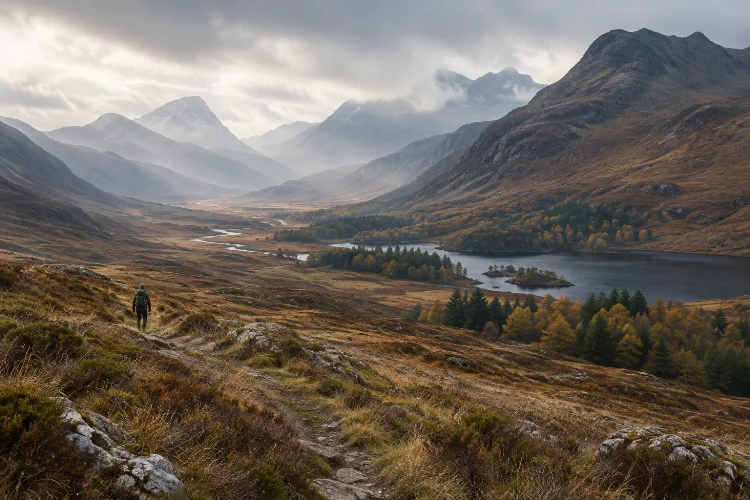
Scotland’s Highlands are famous for dramatic mountains, dark lochs, ruined castles, and roads that seem to disappear into the mist. Yet some of the most memorable places are nowhere near the viewpoints where tour buses stop.
Beyond popular destinations such as Glencoe, Loch Ness, and the Isle of Skye lies another Scotland: long valleys with almost no buildings, old estate tracks fading into open moorland, fragments of ancient woodland, and mountains that can remain completely silent for hours.
Exploring Scotland’s remote Highland valleys is less about ticking off attractions and more about slowing down.
You might spend half a day walking beside a river without passing another person, cycle along a private glen road, or wake beside a loch surrounded by hills rather than hotels.
That freedom does require more planning. Mobile coverage can disappear, weather changes quickly, public transport is limited, and some access arrangements are unusual.
For travellers willing to prepare properly, though, these hidden Highland glens offer something increasingly difficult to find: genuine space, solitude, and a feeling that the landscape is setting the schedule rather than you.
Why Remote Highland Valleys Feel So Different
The Scottish word glen generally refers to a valley, and glens form the natural corridors running between Highland mountains. Some contain villages and major roads. Others stretch deep into the hills with little more than a track, a river, and an occasional estate building.
What makes the quieter valleys special is not necessarily that they are completely unknown. Many are familiar to experienced hillwalkers. The difference is that they rarely function like conventional tourist attractions.
There may be no visitor centre, gift shop, café, marked photo point, or even reliable phone reception. That lack of infrastructure changes the experience immediately.
Instead of moving between attractions, you start noticing smaller details: Scots pine reflecting in dark water, red deer crossing a distant slope, clouds lowering over a ridge, or the sound of a burn becoming louder after rain.
These landscapes also reveal how much of the Highlands remains sparsely populated.
NatureScot identifies 40 National Scenic Areas across Scotland, covering around 13% of the country’s land and including landscapes such as Glen Affric, Glen Strathfarrar, Knoydart, Assynt-Coigach, and Glen Lyon.
The sense of emptiness, however, should not be confused with untouched wilderness. Highland valleys have long histories of crofting, forestry, deer management, hydroelectric development, land ownership, conservation, and community life.
Understanding that makes a trip more interesting. You’re not simply entering empty scenery. You’re travelling through landscapes shaped by generations of people as well as geology and weather.
Glen Affric: Ancient Woodland and Big Mountain Country
If you want a relatively accessible introduction to Scotland’s quieter glens, Glen Affric is difficult to beat.
Located west of Loch Ness, the valley combines lochs, mountains, rivers, open moorland, and extensive native woodland.
Forestry and Land Scotland describes its woodland as one of the best surviving examples of the Caledonian Forest that once covered much larger areas of Scotland. The whole glen is protected as a National Nature Reserve.
The landscape feels especially striking because the forest is not simply a dense wall of trees. Old Scots pines appear between lochs, rocky ground, and open hills, creating a much more varied environment.
Forestry and Land Scotland manages more than 17,000 hectares in the Glen Affric area. Its conservation information records an impressive range of wildlife, including dozens of mammal species and more than 100 recorded bird species.
Most casual visitors stop around Dog Falls, Loch Beinn a’ Mheadhain, or River Affric. Those places are beautiful, but walkers prepared to continue beyond the obvious stopping points quickly find a much quieter landscape.
The public road eventually ends, and the glen continues into mountain terrain. From there, longer tracks can take you toward remote bothies, high passes, and routes connecting with the west coast.
What to Know Before Visiting Glen Affric
Don’t assume you can buy supplies once you’re deep in the glen. Forestry and Land Scotland notes that there are no cafés or shops within Glen Affric itself, while mobile reception can also be limited.
Bring food, water, offline maps, waterproof clothing, and enough time to avoid rushing.
The road is narrow and largely single track, so driving etiquette matters. Use passing places properly and avoid treating them as parking spaces.
Autumn is particularly atmospheric, when birch leaves turn gold and the forest contrasts beautifully with darker hills. Spring can be quieter, while summer provides long daylight hours but usually brings more visitors and, unfortunately, more midges.
Glen Strathfarrar: A Valley Where Access Shapes the Adventure
Glen Strathfarrar feels remote partly because reaching it by car is deliberately controlled.
A long private road leads deep into the glen, surrounded by mountains, hydroelectric infrastructure, woodland, rivers, and open moorland. Walkers and cyclists can access the valley responsibly, but vehicle arrangements are different.
For the 2026 summer season, Mountaineering Scotland states that vehicle access runs from April through October under controlled opening hours. The glen is closed to vehicles on Tuesdays and until 1:30 p.m. on Wednesdays, with a maximum of 25 vehicles permitted per day.
That unusual system naturally reduces traffic.
Once beyond the gate, the glen feels much more isolated than many places reached directly from a major Highland road. Mountain walkers often come for the surrounding Munros, but you do not need to chase summits to appreciate the scenery.
Cycling is an especially enjoyable option because it lets you move slowly through the valley while covering much more ground than you would on foot.
During winter, vehicle access becomes considerably more restricted. The rules can change, so checking current information rather than relying on an old blog post is neccessary.
Glen Strathfarrar is a good example of why exploring remote Scotland rewards people who research the practical details before arriving.
Knoydart: Going Where Public Roads Don’t
Few mainland destinations create a stronger feeling of separation than Knoydart.
The peninsula sits between Loch Nevis and Loch Hourn on Scotland’s west coast. What makes it unusual is simple: there are no public roads connecting it with the rest of Britain’s road network.
According to the Knoydart Foundation, visitors reach the peninsula either by ferry or on foot. The ferry from Mallaig to Inverie typically takes around 30–45 minutes, depending on the service and conditions.
That alone changes the atmosphere.
You cannot simply drive through, take a photograph, and continue toward the next stop. Arriving requires commitment, even if that commitment is only stepping onto a boat.
For walkers, Knoydart’s interior is filled with long valleys, rough tracks, river crossings, isolated hills, and huge stretches of open terrain.
Experienced hikers can also walk into the peninsula. The Knoydart Foundation lists routes from places such as Kinloch Hourn and Glenfinnan, with the latter involving roughly 24 kilometres of travel through remote country.
This is where careful planning becomes more important than Instagram inspiration.
Weather can affect ferries. Distances feel longer when trails are wet. And if you forget something important, the nearest alternative shop is not five minutes down the road.
Stay Long Enough to Slow Down
Knoydart works best when treated as a destination rather than a rushed day trip.
Spend several nights if possible. Base yourself around Inverie, then explore the surrounding glens on foot or by bike.
Using local accomodation, guides, ferries, cafés, and other community businesses also means your visit contributes directly to an area where tourism forms an important part of the local economy.
The Knoydart Foundation itself is community led and manages land and other assets with a focus on sustainable development, biodiversity, renewable energy, and long-term community resilience.
Glen Etive: Look Beyond the Famous Roadside Views
Glen Etive is not exactly secret.
Its winding single-track road has appeared repeatedly in travel photography and film-related itineraries, and its proximity to Glencoe makes it easier to reach than many remote valleys.
Yet there is a major difference between driving down Glen Etive and actually exploring it.
Most visitors concentrate around roadside viewpoints and waterfalls. Walk away from the road, however, and the landscape changes quickly.
The River Etive threads through a long valley surrounded by steep mountains. Small side valleys lead toward rougher terrain, while the main road eventually reaches the head of Loch Etive.
Instead of stopping at every obvious photography point, choose one area and spend several hours walking. Even a modest route can reveal quiet riverbanks, waterfalls, mountain views, and open slopes hidden from drivers.
Glen Etive also illustrates an important challenge facing scenic Highland locations. Increased visitor traffic can place pressure on narrow roads, parking areas, local residents, and fragile ground.
If a parking area is full, don’t invent a new one on the verge. Blocking passing places or gateways creates genuine problems in communities where narrow roads are part of daily life rather than a tourist attraction.
Visiting early, travelling outside peak weekends, and staying longer rather than rushing between viewpoints can make the experience far better.
Assynt and Coigach: A Highland Landscape From Another Planet
Northwest Scotland becomes stranger and more dramatic around Assynt and Coigach.
Instead of continuous mountain ranges, individual peaks rise abruptly from huge areas of moorland, peat, rock, and countless lochs. The result is a landscape that feels enormous even when the mountains themselves are not Scotland’s highest.
NatureScot highlights the Assynt-Coigach National Scenic Area for its distinctive combination of isolated mountains, lochans, moorland, and coastal scenery.
Stac Pollaidh is one of the best-known walks, but it is only the introduction.
Travel farther into the surrounding country and there are valleys and tracks where you may encounter far fewer people. Routes around Quinag, Cul Mor, Suilven, Inverpolly, and the Glencoul area can provide a much deeper sense of the northwest landscape.
The terrain can also be deceptively slow.
A distance that looks short on a map might cross boggy ground, rough heather, streams, rocks, and sections with little obvious path. Ten kilometres of Highland terrain is not always equivalent to ten kilometres on a maintained trail.
Plan according to terrain rather than distance alone.
How to Explore the Highlands Without Depending on Tourist Trails
Going beyond the main Highland tourist routes does not mean wandering randomly into the mountains.
In fact, the quieter the destination, the more deliberate your planning should be.
Start with a proper map and understand what the symbols mean. Download offline mapping before leaving areas with good reception, but carry a physical map and compass when heading into genuinely remote country.
Mountaineering Scotland notes that navigation in Scottish mountains can become difficult very quickly when visibility deteriorates. A path shown on a map may not always be clearly visible on the ground.
Weather deserves the same respect.
Highland conditions can shift dramatically within hours. Sunshine in the valley does not guarantee good conditions higher up, while prolonged rain can turn small burns into difficult river crossings.
Mountaineering Scotland recommends using mountain-specific forecasts rather than relying only on general town forecasts. It also points out that strong wind can significantly affect balance and movement, while heavy rain can make previously manageable stream crossings dangerous.
A sensible day therefore starts with the forecast, not with a fixed itinerary.
If the wether looks poor on the western mountains, you may be better choosing a lower valley walk or moving to another area entirely.
Flexibility is one of the most valuable skills in Scotland.
Wild Camping, Bothies, and Responsible Access
Scotland offers unusually broad outdoor access rights compared with many countries.
Under the Scottish Outdoor Access Code, responsible access generally applies across most land and inland water for activities including walking, cycling, climbing, wildlife watching, and swimming. Those rights do not automatically extend to motor vehicles.
Responsible lightweight camping is also permitted in many places where access rights apply. The key word is responsible.
That means avoiding buildings and enclosed fields, keeping groups small, removing all litter, dealing with human waste properly, and leaving no obvious sign that you were there.
Don’t assume a quiet glen is unoccupied just because you cannot see anyone. Estates, crofts, conservation workers, forestry teams, stalkers, farmers, and residents may all be using the landscape.
Bothies can provide another memorable way to experience the remote Highlands. These simple mountain shelters are generally basic rather than serviced huts, so visitors should arrive capable of looking after themselves.
Never depend on a bothy as though it were a guaranteed hotel room.
Carry enough equipment to remain safe even if the building is full, inaccessible, or unusable.
Choosing the Best Time for Remote Highland Travel
There is no single perfect season.
May and early June are popular among experienced Highland travellers because daylight is long, vegetation is fresh, and midge numbers can be lower than later in summer. Conditions vary each year, though, so nothing is guaranteed.
July and August provide extremely long days and generally easier logistics, but popular valleys can be busier. Midges are also capable of turning a peaceful evening beside a loch into a test of character.
September often brings a good balance of changing colours, softer light, and fewer visitors.
October can be spectacular, particularly in wooded glens such as Glen Affric, although daylight becomes noticeably shorter and Atlantic weather can become more aggressive.
Winter is a completely different experience.
Snow, ice, limited daylight, freezing temperatures, and avalanche conditions can transform familiar summer walks into serious mountaineering objectives. People without winter skills should stick to appropriate lower-level routes or join qualified guides.
The most useful approach is not searching for the “best month,” but matching your trip to your experience.
A beginner may enjoy a remote valley enormously without ever climbing above the glen floor.
Travel Slowly and Leave the Highlands Better Than You Found Them
The biggest mistake when exploring Scotland’s quieter valleys is trying to collect too many of them.
A route that includes Glen Affric in the morning, Glencoe in the afternoon, and another remote glen before sunset may look efficient on a map, but it misses the point.
Pick fewer places.
Walk farther.
Sit beside the river for a while.
Buy food in a local village. Stay in a community-run hostel, guesthouse, or campsite. Speak to people who live there. Learn why a woodland is being restored or why vehicle access is restricted.
Responsible travel is not complicated. Scotland’s Outdoor Access Code is built around three basic principles: respect other people’s interests, care for the enviroment, and take responsibility for your own actions.
Those principles become even more important when you leave heavily managed visitor sites behind.
Remote places remain special partly because people have not overwhelmed them with the infrastructure required to manage careless behaviour.
Keeping them that way is part of the journey.
Exploring Scotland’s remote Highland valleys offers a side of the country that cannot really be experienced from scenic lay-bys or rushed road trips.
Places such as Glen Affric, Glen Strathfarrar, Knoydart, Glen Etive, and the wild landscapes of Assynt reveal ancient woodland, enormous mountain spaces, isolated communities, wildlife, and some of Britain’s most rewarding walking country.
The trade-off is simple: fewer facilities mean more responsibility. Check access arrangements, understand the forecast, carry reliable navigation, respect local communities, and avoid leaving evidence of your visit.
Most importantly, give these landscapes time.
Choose one quiet glen, leave the crowded itinerary behind, and spend a full day discovering what lies beyond the obvious trail. The Scotland you remember most may be the part where almost nothing appears on the tourist map.