
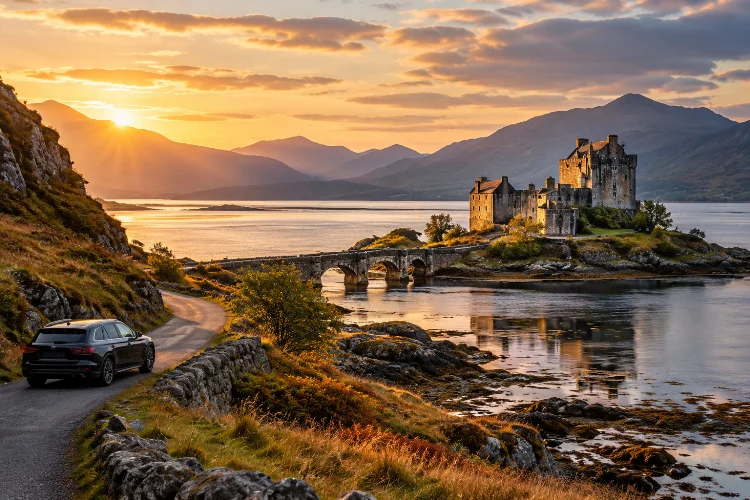
Some castles are impressive because of their architecture. Scottish castles often have something extra: a landscape that seems specifically designed to make them look dramatic.
Edinburgh Castle rises above the capital from volcanic rock. Dunnottar sits on a cliff surrounded by the North Sea. Urquhart looks across Loch Ness, while Eilean Donan occupies a tiny island where three sea lochs meet.
Visiting them individually is easy. Connecting them into a meaningful journey is much more interesting.
Planning heritage routes around Scotland’s most dramatic castles allows you to follow centuries of royal ambition, clan rivalry, warfare, rebellion, and architectural change while travelling through some of the country’s best scenery.
The trick is not trying to see every castle.
A good route links a manageable number of historic sites with nearby towns, landscapes, museums, and scenic drives. It also leaves enough time to explore rather than simply photograph each fortress from the car park.
From Edinburgh and Stirling to Dunnottar, Loch Ness, and the western Highlands, Scotland is almost perfectly built for this type of slow historical road trip.
Why Build a Heritage Route Instead of Visiting Random Castles?
A list of castles can quickly become repetitive.
You arrive, photograph the walls, read a few signs, climb a staircase, return to the car, and repeat.
A heritage route gives each stop context.
Edinburgh and Stirling, for example, tell different parts of the same royal story. Both were major residences of Scottish monarchs, but Stirling’s position above the River Forth gave it enormous strategic value as a gateway between northern and southern Scotland.
Move east toward Tantallon and the story changes.
Instead of royal government, you encounter the power of the Douglas family and a fortress designed around enormous medieval walls and coastal cliffs.
Continue north to Dunnottar and Scotland’s political story becomes mixed with dramatic geology, the Wars of Independence, Mary Queen of Scots, Covenanters, and the protection of the Scottish Crown Jewels.
By the time you reach Eilean Donan or Urquhart, you are in another political world shaped by Highland clans, sea routes, Jacobite conflict, and competition for control of northern territories.
This progression makes the journey feel connected.
You are not just collecting castles.
You are watching Scotland change region by region and century by century.
Route One: Edinburgh Castle and the East Lothian Coast
Edinburgh is the most practical starting point for a castle-focused trip.
The city has excellent transport connections, plenty of accomodation, and one of the most historically important fortresses in Scotland sitting directly above its centre.
Edinburgh Castle began as a fortified site on volcanic Castle Rock and later became one of Scotland’s main royal residences during the 15th and 16th centuries.
After the Lang Siege of 1571-73, its military function became increasingly important, with major improvements to its defences and garrison facilities.
Give yourself at least half a day.
St Margaret’s Chapel, Crown Square, the Great Hall, Royal Palace, defensive batteries, and views across Edinburgh each represent different periods of the castle’s history.
Do not treat the view as an optional bonus.
Looking across the city from Castle Rock explains instantly why the location was so valuable.
Continue East to Tantallon Castle
Rather than immediately heading north, spend another day travelling east toward North Berwick.
Tantallon Castle provides an excellent contrast to Edinburgh.
Built by William Douglas in the mid-14th century, Tantallon was one of the last great medieval castles constructed in Scotland. It relied on a huge defensive curtain wall facing inland, while steep coastal cliffs provided natural protection on the other sides.
That relationship with the landscape makes the castle spectacular.
The Bass Rock sits offshore, waves crash below the cliffs, and the ruins feel much more isolated than their location relatively close to Edinburgh might suggest.
Tantallon also survived repeated conflict.
James IV besieged it in 1491, James V attacked it in 1528, and Cromwell’s forces caused devastating damage in 1651. The fortress was largely abandoned afterward.
Allow time for North Berwick as well.
Combining castle history with a coastal town prevents the day from becoming another rushed sequence of monuments.
Route Two: Stirling and Scotland’s Royal Heartland
From Edinburgh, travel west toward Stirling.
You could technically see Edinburgh and Stirling Castles on the same day.
Don’t.
Both deserve enough time to understand why they mattered.
Stirling Castle stands on a volcanic outcrop above the River Forth and historically guarded one of the most important crossing points between the Highlands and Lowlands. During the Wars of Independence, possession of the fortress changed repeatedly between Scottish and English forces.
Nearby battles make the geography even more meaningful.
William Wallace and Andrew Murray defeated English forces at Stirling Bridge in 1297. Robert the Bruce later achieved his famous victory at Bannockburn in 1314.
Stirling subsequently developed into one of Scotland’s grandest royal centres.
James IV constructed the King’s Old Building and Great Hall, while James V added the magnificent Royal Palace. Mary Queen of Scots was crowned at Stirling in 1543.
Use Stirling as a Two-Night Base
Staying locally gives you a more relaxed heritage route.
Spend the first afternoon walking through Stirling’s Old Town. Visit the castle the following morning when you are fresh, then explore other sites around the Forth Valley later.
This approach is much more enjoyable than constantly packing luggage and changing hotels.
It also gives you time to connect the castle with its surrounding landscape.
From the ramparts, look toward the river, Highlands, and routes leading across central Scotland.
Suddenly the famous description of Stirling as a link between Highlands and Lowlands stops sounding like a history-book phrase and starts becoming visually obvious.
Route Three: Dunnottar and the Aberdeenshire Coast
The journey toward northeast Scotland introduces one of the country’s most cinematic ruins.
Dunnottar Castle stands on a rocky headland about 160 feet above the North Sea, just south of Stonehaven. The position is so dramatic that the approach itself feels like part of the attraction.
But Dunnottar is more than a photography stop.
The site’s history stretches back long before the surviving medieval buildings. Viking attack, the Wars of Independence, the Keith family, Mary Queen of Scots, Covenanters, Jacobitism, and the Scottish Crown Jewels all appear in its long story.
Sir William Keith built the stone keep around 1392.
The Keiths later became Earls Marischal and controlled Dunnottar for centuries. Mary Queen of Scots visited in 1562 and returned in 1564.
Perhaps the castle’s most famous episode came during the 17th century, when the Honours of Scotland – the nation’s Crown Jewels – were protected from Oliver Cromwell’s forces.
That story becomes even more powerful once you see how difficult the castle would have been to approach.
Stay in Stonehaven Rather Than Rushing North
Dunnottar is only around 1.6 miles south of Stonehaven, and the town makes an excellent base for the night.
If the weather is reasonable, walk part of the coastal route rather than arriving and leaving entirely by car.
The castle’s silhouette gradually appearing along the cliffs creates a much better sense of place.
Weather matters here.
Dunnottar can close at short notice during high winds, snow, or ice because of its exposed cliff-top position. It operates year-round under normal conditions, but current access should always be checked on the day of travel.
This is one reason heritage routes need flexibility.
A rigid itinerary that allows only two hours for Dunnottar can fail completely if coastal weather turns bad.
Route Four: Urquhart Castle and the Great Glen
After central and northeast Scotland, head into the Highlands.
Urquhart Castle offers one of the most satisfying combinations of history and scenery in the country.
The ruins occupy a promontory on the western shore of Loch Ness near Drumnadrochit.
Edward I of England captured the castle in 1296 during his invasion of Scotland. It later returned to Scottish control and eventually became associated with Robert the Bruce.
During the later Middle Ages, the MacDonald Lords of the Isles repeatedly fought to control the fortress as they expanded their influence eastward.
The struggle lasted for generations.
James IV granted Urquhart and its lands to the Grant family in 1509, tasking them with restoring and controlling the castle. The Grants later built the prominent five-storey Grant Tower.
The fortress finally lost its military role following the political crisis of the late 17th century.
Government troops garrisoned Urquhart after James VII and II was driven into exile. When they left in 1692, they deliberately blew up the gatehouse so Jacobite forces could not use the castle.
What remained became the romantic ruin visitors see today.
Don’t Make Loch Ness a One-Hour Stop
Urquhart is often squeezed into fast Highland tours.
A slower route works better.
Stay near Inverness or Drumnadrochit and use the castle as part of a full day exploring the Great Glen.
Urquhart is also one of Scotland’s most visited castles, and tickets can sell out well ahead of time in summer. Parking is limited and is only guaranteed with an advance online booking.
This is one stop where booking ahead is definately worth the effort.
After the castle, continue exploring Loch Ness rather than immediately driving toward another famous landmark.
The landscape is part of the heritage story.
Route Five: Eilean Donan and the Western Highland Gateway
Eilean Donan is probably one of the most photographed castles in Europe.
Its setting makes it obvious why.
The castle occupies a small island where Loch Duich, Loch Long, and Loch Alsh meet, surrounded by Highland mountains and connected to the mainland by a stone bridge.
A fortified structure was established there in the early 13th century, probably as part of efforts to protect Kintail during a period when Norse power still influenced western Scotland.
This is where understanding geography completely changes the story.
Modern visitors tend to think of sea lochs as obstacles between places.
In medieval western Scotland, water was often the fastest route.
Political power depended on boats, island strongholds, and control of coastal territory.
Eilean Donan eventually became closely connected with the Mackenzies of Kintail and the MacRaes. By the 16th century, the fortress was also adapted for gunpowder warfare with the addition of a firing platform for cannon.
The Castle You See Is Also a 20th-Century Reconstruction
One detail makes Eilean Donan particularly interesting.
The castle was largely destroyed in 1719 after Spanish troops supporting a Jacobite uprising occupied the site. Government warships bombarded the castle, and troops later used hundreds of barrels of captured gunpowder to demolish what remained.
The ruins remained abandoned for almost 200 years.
Lieutenant Colonel John MacRae-Gilstrap purchased the island in 1911 and spent roughly two decades reconstructing the castle. The work was completed in 1932.
So when you photograph Eilean Donan, you are seeing a combination of medieval heritage and modern restoration.
That does not make it less authentic as a historical destination.
It makes the story more complicated, which is far more interesting.
Use Eilean Donan as a Gateway, Not an Endpoint
The castle works naturally within a route toward the Isle of Skye, Glenelg, or the wider northwest Highlands.
Avoid the temptation to stop for twenty minutes, take the classic bridge photograph, and leave.
Walk around the shoreline if conditions allow. Study how the lochs intersect. Look back toward the mountains.
Current visitor information for 2026 shows that opening hours vary significantly throughout the year, and January is normally closed. Tickets are purchased on-site rather than through an advance online booking system.
Checking seasonal information is therefore neccessary when building your route.
How to Turn These Castles Into a 7–10 Day Heritage Route
Seven days is enough for a focused journey.
Ten days is much better.
For a one-week version, spend two nights in Edinburgh, one around Stirling, one near Stonehaven, one around Inverness or Loch Ness, and two nights in the western Highlands.
That gives you time for the major castles without spending the entire holiday in the car.
With ten days, slow the route further.
Add a second night around Stirling, spend additional time along the Aberdeenshire coast, or remain near Eilean Donan before continuing toward Skye.
Do not calculate the itinerary based only on driving time.
A castle that appears to require two hours can easily occupy half a day once you add parking, walking, exhibitions, lunch, photography, and nearby historic streets.
The best rhythm is usually one major castle per day, occasionally two when they are close together.
Build Around Geography
A logical direction might look like this:
Edinburgh → Tantallon → Stirling → Dunnottar → Urquhart → Eilean Donan
This is not the only option.
What matters is avoiding constant backtracking.
You can also reverse the route if arriving from Inverness or travelling down from the Highlands.
For travellers relying on public transport, Edinburgh, Stirling, and Stonehaven are easier to incorporate than remote Highland sites.
A rental car becomes much more useful once the itinerary moves toward Loch Ness and the western Highlands.
Choose Castles for Different Stories, Not Just Different Views
A dramatic castle itinerary becomes more engaging when every stop contributes something new.
Edinburgh represents royal government and military adaptation.
Stirling connects kingship with control of a crucial river crossing.
Tantallon shows the power of a noble family challenging the Crown.
Dunnottar demonstrates how extreme landscape and political crisis can turn a fortress into a refuge.
Urquhart reveals competition between royal authority and Highland power.
Eilean Donan links maritime geography, clan history, Jacobitism, destruction, and modern reconstruction.
That variety prevents “castle fatigue.”
It also gives you better stories to remember.
Instead of returning home with hundreds of similar photographs, you remember why one wall was enormous, why another castle was deliberately destroyed, and why a tiny island could matter politically.
Timing Your Castle Route for a Better Experience
Late spring is one of the easiest periods for castle travel.
Days are long, landscapes are green, and visitor numbers are generally more manageable than during the busiest summer weeks.
Summer provides maximum daylight but also brings larger crowds at famous attractions.
Edinburgh and Urquhart are particularly worth booking ahead during peak travel periods. Historic Environment Scotland currently recommends advance booking at Edinburgh, while Urquhart warns that summer tickets may sell out well in advance.
Autumn can be excellent.
Lower visitor numbers, softer light, changing foliage, and atmospheric weather suit historic sites beautifully.
Winter requires more preparation.
Days are short, seasonal hours become reduced, and exposed places can close because of severe weather. Dunnottar in particular may close when high winds or icy conditions make the cliff-top site unsafe.
Whatever the season, leave one flexible half-day somewhere in the schedule.
Scotland’s weather has little interest in your spreadsheet.
Practical Tips for a Smoother Heritage Road Trip
Book your highest-demand sites first, then build the rest of the route around them.
This is especially useful for Edinburgh and Urquhart.
For Eilean Donan, where 2026 admission is purchased on arrival, plan around the published opening schedule instead.
Wear proper shoes.
Dramatic castles often involve slopes, uneven stone, stairs, grass, cobbles, and exposed paths. Dunnottar’s spectacular location comes with obvious access challenges, while parts of Tantallon involve gravel, grass, bridges, and potentially muddy ground.
Keep waterproof clothing in the car.
Do not cancel a castle day simply because the sky is grey. Moody weather often suits ruined fortresses better than perfect blue skies.
Most importantly, resist overplanning.
If you discover a coastal walk, interesting village, historic church, or local museum beside the route, give yourself enough space to stop.
Heritage travel works best when the journey can occasionally surprise you.
Planning heritage routes around Scotland’s most dramatic castles is about connecting history with landscape rather than racing between famous landmarks.
Edinburgh and Stirling reveal Scotland’s royal and military heart. Tantallon and Dunnottar place medieval power against spectacular coastal scenery, while Urquhart brings the journey into the conflicts of the Highlands.
Eilean Donan finishes the story with clans, Jacobitism, destruction, and one of Scotland’s most famous restored strongholds.
The ideal route is not the one with the most castles.
It is the one that gives each place enough time to make sense.
Choose five or six strong locations, stay several nights in key regions, leave space for weather and detours, and let the landscape connect the history for you. That is when a Scottish castle trip becomes a real heritage journey.