
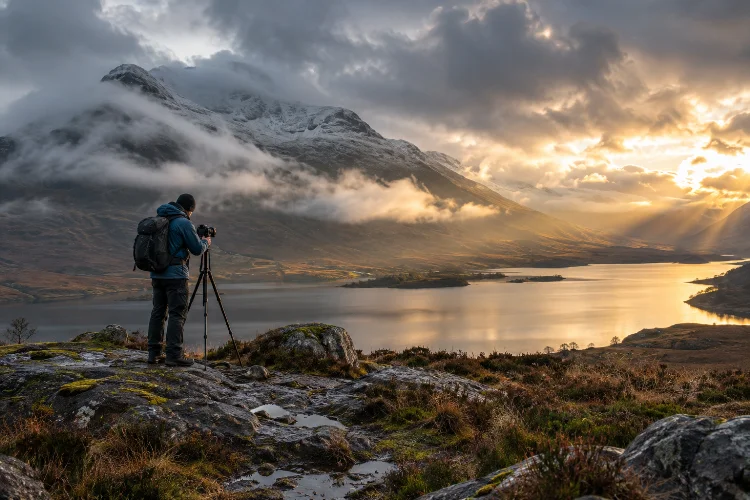
Scotland’s Highlands are incredibly photogenic, but they are not particularly interested in following your itinerary.
You can arrive at a famous mountain viewpoint under completely flat grey skies, then discover spectacular light twenty minutes later beside an unnamed loch.
Fog can hide a summit all morning before suddenly lifting. A rainy afternoon may produce better images than the perfect sunrise you planned for weeks.
That unpredictability is exactly why designing extended Highland itineraries for landscape photography works better than racing between famous locations.
An extended trip gives you something every landscape photographer needs: time. Instead of expecting one sunrise to deliver, you can revisit locations, change regions when the forecast shifts, scout compositions in daylight, and wait for conditions that actually suit the landscape.
Scotland has 40 designated National Scenic Areas covering around 13% of its land, including Ben Nevis and Glencoe, Wester Ross, Assynt-Coigach, Glen Affric, and the Cairngorm Mountains.
The challenge is not finding beautiful scenery.
It is designing a trip that gives you enough flexibility to photograph it well.
Why Longer Highland Photography Trips Usually Work Better
A normal sightseeing itinerary is built around destinations.
Landscape photography needs to be built around conditions.
That difference matters.
Imagine you have allocated one evening to Glencoe. You arrive at 5 p.m., photograph Buachaille Etive Mòr, sleep nearby, and leave for Torridon the following morning.
Efficient? Yes.
Reliable for photography? Not really.
If that evening produces heavy rain and low cloud, your only opportunity is gone. Stay for three nights, however, and suddenly you have several sunsets, sunrises, weather transitions, and opportunities to explore different compositions.
Extended itineraries also reduce one of the biggest problems with photography road trips: constantly arriving somewhere at the wrong time.
Driving four hours during the best evening light because your next hotel is far away is frustrating. So is reaching a promising location at noon, taking an average photograph, and immediately leaving because another famous spot is waiting.
A slower journey lets photography determine the schedule rather than accommodation bookings controlling every hour.
This matters particularly in the northwest Highlands, where single-track roads and frequent stops can make travel significantly slower than mileage suggests.
VisitScotland recommends at least five to seven days for the 516-mile North Coast 500 alone and specifically advises travellers to prepare for changing weather, use designated parking, and carry offline maps.
For photographers, even seven days can feel rushed.
Ten days to two weeks provides much more breathing room.
Build the Itinerary Around Regions, Not Individual Photo Spots
One of the easiest mistakes is building a Highland photography trip from individual Instagram locations.
“Buachaille Etive Mòr. Check. Torridon. Check. Stac Pollaidh. Check.”
That approach creates impressive mileage and surprisingly little meaningful photography.
Instead, divide the Highlands into photographic regions and give each region several days.
Glencoe, Rannoch Moor, and Glen Etive
Glencoe is an obvious starting point because it packs a remarkable amount of landscape variety into a relatively compact area.
Rannoch Moor provides open peatland, lochans, reflections, and distant mountain layers. Continue west and Buachaille Etive Mòr becomes the dominant subject before the road enters the deeper Glencoe landscape.
A turn into Glen Etive introduces rivers, waterfalls, woodland, intimate mountain details, and eventually Loch Etive.
VisitScotland’s own photography-oriented material highlights Rannoch Moor, Blackrock Cottage, Buachaille Etive Mòr, Glen Etive, and the wider Glencoe valley as major photographic subjects.
Three nights here is a good minimum for an extended photography trip.
Use one afternoon purely for scouting. Find possible foregrounds, check safe parking, identify where mountains sit relative to the setting sun, and note which locations might work in rain rather than clear skies.
Then return when the light changes.
The Highlands often reward repetition more than constant movement.
Torridon and Wester Ross
Torridon is where photographers can easily lose track of time.
Massive Torridonian sandstone mountains rise above sea lochs, native woodland, rivers, and open moorland. Reflections can appear on calm mornings, while storm clouds make the landscape feel almost prehistoric.
In August 2026, Torridon was designated Scotland’s newest National Nature Reserve. The reserve covers about 5,100 hectares from the shores of Loch Torridon to mountains including Beinn Alligin and Liathach.
Together with neighbouring Beinn Eighe NNR, the area contains roughly 18 miles of maintained mountain and lower-level paths.
That makes Torridon useful for much more than roadside photography.
You can photograph lochs at dawn, explore woodland during poor light, walk toward elevated viewpoints when conditions are stable, or concentrate on small details when mountain tops disappear.
NatureScot also identifies Wester Ross as one of Scotland’s major National Scenic Areas, noted for its mountain landscapes and wild coastal character.
Give Torridon at least two full days.
Three is better.
The extra time allows you to respond to reflections, mist, changing cloud levels, and unexpected shafts of light rather than forcing one specific composition.
Assynt and Coigach
Assynt feels different from almost everywhere else in Scotland.
Instead of continuous mountain ranges, isolated peaks rise dramatically from a landscape of moorland, rock, lochans, and peat.
Stac Pollaidh, Suilven, Cul Mor, Quinag, and Canisp create distinctive silhouettes that work exceptionally well with changing light.
NatureScot specifically highlights the panorama over the Assynt-Coigach National Scenic Area from Stac Pollaidh, while gentler trails such as Leitir Easaidh provide accessible mountain views without requiring a major ascent.
Knockan Crag is another useful option. Its higher trail provides broad views toward Coigach and Assynt, making it valuable for scouting larger landscape relationships before deciding where to spend sunrise or sunset.
A photographer could easily spend four or five days around Lochinver and Ullapool without running out of subjects.
This is also where an extended itinerary really pays off.
If Stac Pollaidh disappears behind cloud, photograph the coast. If wind destroys reflections, work with moving water or textures in the moorland. If rain arrives, look for waterfalls and saturated autumn colours rather than waiting miserably in the car.
Bad conditions rarely mean no photography.
They usually mean changing the subject.
Let Light Decide the Daily Schedule
Landscape photographers have a strange relationship with sleep.
A normal tourist may be eating breakfast when you are already returning from several hours outside.
That is particularly noticeable during Scottish summer, when sunrise can arrive very early and sunset very late.
Trying to photograph both sunrise and sunset every single day for two weeks is usually a terrible plan. You will eventually become exhausted, drive while tired, stop scouting properly, and start producing worse images.
Instead, design a rhythm.
Choose certain mornings for sunrise and others for sleeping. Use midday for scouting, travel, food, editing, charging batteries, or exploring woodland where harsh directional light matters less.
Then concentrate again around evening light.
Autumn is especially attractive because the day becomes easier to manage. Sunrise occurs later, sunset comes earlier, and changing vegetation provides additional colour.
Late autumn and winter offer even shorter daylight, although mountain conditions become more serious.
Do not assume dramatic photography requires sunshine, either.
Overcast skies can work beautifully for waterfalls, forests, streams, and intimate landscapes. Rain creates saturated colours. Fog simplifies complicated scenes. Broken cloud can produce far more interesting light than a completely clear sky.
A flexible photographer asks, “What can I photograph in these conditions?”
Not, “Why isn’t the weather doing what I planned?”
That small change in mindset can rescue entire days.
Design Buffer Days Around Highland Weather
A photography itinerary should contain empty space.
Seriously.
One of the best things you can put into a spreadsheet is a day with almost nothing scheduled.
Scottish mountain weather can change rapidly, and conditions may differ considerably between west and east. Mountaineering Scotland recommends using the weather forecast to make your plans rather than choosing a fixed route and simply checking what conditions you will have to endure.
That advice is almost perfect for photographers.
If Wester Ross looks completely washed out while the eastern Highlands have clearer conditions, consider moving. If the forecast predicts improving weather in the afternoon, spend the morning scouting rather than abandoning the day.
Mountain-specific forecasts are particularly helpful.
The Met Office provides regional forecasts for areas including the Northwest Highlands, North Grampian, Southwest Highlands, and South Grampian, with forecasts updated daily and information about conditions at different elevations.
Wind matters more than many photographers expect.
Mountaineering Scotland notes that winds above around 35 mph can affect the balance of a fit adult. Strong wind also makes tripod work difficult and can turn exposed viewpoints into poor choices even when the sky looks promising.
Plan one or two buffer days into a 10- to 14-day itinerary.
Do not assign them to a fixed place until the forecast becomes clearer.
That flexibility is worth far more than squeezing another famous location onto the schedule.
Use Fewer Bases and Spend More Time Photographing
Changing hotels every night sounds efficient until you actually do it with photography equipment.
Pack camera bag.
Pack clothes.
Check drawers.
Load vehicle.
Check out.
Drive.
Wait for check-in.
Unload.
Repeat tomorrow.
You lose a surprising amount of creative energy.
A better approach is choosing strategic bases for several nights.
For example, an extended western Highlands trip might spend three nights around Glencoe or Ballachulish, three nights in Torridon, four nights around Lochinver or Ullapool, then keep two flexible nights for wherever the weather looks most interesting.
This structure dramatically reduces daily logistics.
It also means you can revisit compositions.
You might scout a loch in strong wind on the first afternoon and notice a promising arrangement of rocks in the foreground. The following morning is calm, so you return before sunrise and photograph reflections from a position you already understand.
That is far more effective than arriving in darkness at an unfamiliar location and hoping everything magically works.
A Practical 12-Day Photography Framework
For a 12-day trip, think in blocks rather than a rigid sequence.
Spend days one to three around Glencoe, Rannoch Moor, and Glen Etive. Use the first afternoon for scouting and reserve the next two sunrise and evening sessions for locations matched to the weather.
Move north on day four and make the drive itself part of the photography day rather than treating it as lost time.
Days four to six can focus on Torridon, Loch Maree, Beinn Eighe, and surrounding Wester Ross.
Days seven to ten can move farther north toward Assynt and Coigach. Stay around Ullapool or Lochinver, depending on the subjects you want to prioritise.
Keep days eleven and twelve flexible.
If Assynt finally gets the conditions you were waiting for, stay. If Glencoe suddenly looks better, begin moving south. If everywhere is stormy, work on woodland, waterfalls, coastal scenes, villages, and detail photographs rather than trying to force high viewpoints.
The framework provides direction without destroying spontaneity.
That balance is what an extended photography trip needs.
Scout Beyond the Famous Compositions
There is nothing wrong with photographing iconic Highland scenes.
Buachaille Etive Mòr is famous because it is genuinely spectacular.
Stac Pollaidh is photographed constantly because its profile is extraordinary.
The problem begins when photographers travel hundreds of kilometres only to reproduce the same viewpoint they saw online.
Use famous locations as starting points.
Arrive early and walk around.
Try longer focal lengths rather than automatically reaching for an ultra-wide lens. Look behind you. Pay attention to layers in the mountains, reflections, water patterns, isolated trees, rocks, mist, and small patches of light.
Some of your strongest photographs may be made less than a kilometre from the famous composition but facing the opposite direction.
Walking also changes what becomes possible.
NatureScot’s network of National Scenic Areas includes landscapes ranging from Assynt-Coigach and Wester Ross to Ben Nevis and Glencoe, with walking opportunities that reveal perspectives impossible to photograph from roadside lay-bys.
You do not necessarily need to climb major mountains.
Even twenty or thirty minutes away from the road can change elevation, foreground, noise levels, and visual relationships enough to create a much more original composition.
Just leave enough time to return safely.
Chasing sunset light farther and farther from the vehicle becomes less romantic when you realise the entire walk back will be in darkness.
Carry a headtorch even if you think you will be finished before dark.
You probably won’t be.
Keep the Photography Kit Practical
Extended Highland trips encourage overpacking because you have a vehicle.
That does not mean you need to carry everything into the landscape.
A practical kit might include one camera body, a wide-to-standard zoom, a telephoto zoom, a sturdy tripod, cleaning equipment, spare batteries, lens cloths, waterproof protection, and filters if they suit your style.
Longer lenses are particularly useful in Scotland.
Mountain layers, distant light, isolated peaks, and small areas of atmospheric conditions can look much stronger at 100–300mm than through a dramatic ultra-wide composition.
Keep a simple “walk kit” seperately from equipment that remains in the car.
Waterproof jacket and trousers, warm layers, gloves, headtorch, food, water, navigation equipment, and a small emergency kit matter more than carrying a fourth lens you probably will not use.
Camera equipment also needs protection from constant moisture.
Rain is obvious, but condensation can be just as annoying. Moving cold equipment directly into a warm room may cause moisture to form on lenses and camera bodies.
Keep lens cloths accessible rather than buried at the bottom of the bag.
Backups matter too.
Copy images regularly to at least one additional drive, and ideally maintain another copy somewhere seperate from your primary storage. Losing twelve days of photographs because one drive failed would be considerably more painful than missing a sunset.
Photograph Responsibly and Respect Access
Landscape photography does not create a special right to park wherever the composition looks good.
This is important in the Highlands, where many roads are narrow and small areas beside roads have practical purposes.
The Scottish Outdoor Access Code states that access rights do not include motor vehicles. Drivers should avoid blocking entrances, roads, tracks, or damaging verges and should use established parking areas where available.
That means a beautiful foreground is not a reason to abandon your car in a passing place.
Park safely and walk back.
Scotland otherwise provides generous responsible access to most hills, woods, beaches, lochs, and open countryside. The three basic principles are respecting other people’s interests, caring for the environment, and taking responsibility for your actions.
Those principles apply directly to photographers.
Avoid trampling fragile vegetation simply to move a tripod one metre closer. Do not disturb wildlife for a shot. Respect temporary land-management advice. Take litter home.
If your extended itinerary includes camping, responsible lightweight camping is generally possible where access rights apply. Current guidance recommends small numbers and normally no more than two or three nights in one place.
Camping can be brilliant for photography because it puts you close to sunrise locations.
But treat it as a privilege rather than free accomodation.
The best landscape photographs should not require damaging the landscape that made them possible.
Designing extended Highland itineraries for landscape photography is really an exercise in giving yourself options.
Spend several nights in each region instead of collecting locations. Build around Glencoe, Torridon, Wester Ross, and Assynt rather than isolated viewpoints. Scout before the best light, use mountain forecasts to decide where to go, and protect a few days from fixed bookings.
Most importantly, stop expecting every sunrise to perform.
The Highlands are interesting because conditions change constantly. Mist, rain, wind, broken clouds, reflections, and sudden light can all produce completely different photographs of the same landscape.
Plan the structure, then leave enough freedom for Scotland to change it.
Pack your camera, choose two or three regional bases, add at least one weather buffer day, and start building an itinerary where waiting is part of the creative process.