
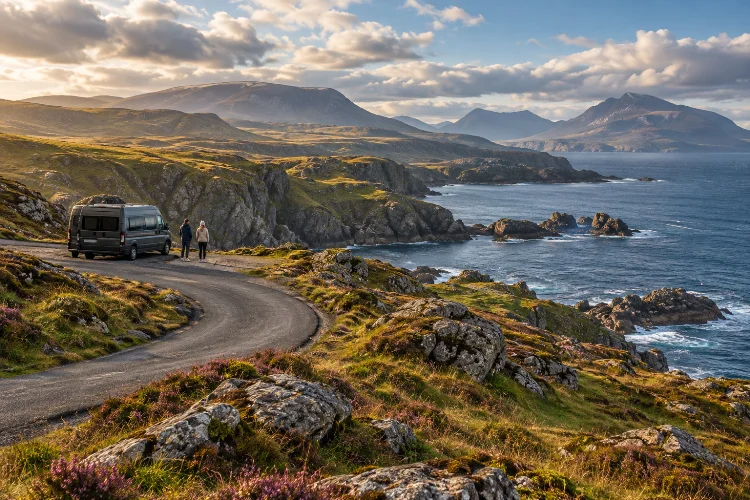
The North Coast 500 is often presented as one simple challenge: start in Inverness, drive roughly 500 miles around northern Scotland, return to Inverness, and collect as many famous stops as possible along the way.
That approach works, but it is definitely not the only way to experience the region.
In fact, exploring the North Coast 500 through alternative driving itineraries can create a better trip if you have limited time, dislike changing hotels every night, travel in a large vehicle, or simply want to experience the Highlands at a slower pace.
The official route covers 516 miles, or around 830 kilometres, and links Inverness with Wester Ross, Sutherland, Caithness, Easter Ross and some of Scotland’s most dramatic coastal landscapes.
The NC500 organisation and VisitScotland recommend allowing at least five to seven days for the complete circuit rather than racing around it.
But you do not actually have to complete the whole loop.
A western Highlands sampler, a north-coast journey, a series of regional bases, or a slower eight-day circuit can often provide a more memorable experience.
Why an Alternative NC500 Itinerary Can Be Better
The biggest problem with a standard North Coast 500 itinerary is not the route.
It is the temptation to do too much.
A map makes 516 miles look manageable. Technically, the route can be driven surprisingly quickly if you barely stop.
VisitScotland estimates that the driving itself takes around 13 hours and 35 minutes without sightseeing, but specifically recommends spreading the journey across several days.
Real road-trip time is very different.
You will want to stop at beaches, ruined castles, mountain viewpoints and small villages. Single-track roads reduce average speeds, and a lunch stop that was supposed to take 30 minutes can easily become two hours when the harbour looks good and nobody feels like leaving.
Then there is the weather.
A rainy morning in Assynt may encourage you to spend more time around Ullapool. Clear skies in Torridon might tempt you into an unexpected walk. A route that leaves no room for those decisions starts feeling like work.
The official NC500 guide itself suggests exploring only a smaller section of the route when time is limited. It also encourages travellers with more time to slow down and explore places beyond the obvious highlights.
That is the key idea.
The NC500 is a framework, not a rulebook.
Alternative Itinerary One: A Four-Day West Coast Sampler
If dramatic mountains matter more to you than completing the entire loop, concentrate on the western section.
This is the part of the route most strongly associated with steep Highland scenery, sea lochs, narrow mountain roads, white beaches and places such as Applecross, Torridon, Ullapool and Assynt.
Day 1: Inverness to Torridon
Leave Inverness and head west through the interior toward Achnasheen, Kinlochewe and Torridon.
The landscape becomes increasingly dramatic as you move toward Wester Ross. Instead of trying to squeeze Applecross into the first day, consider making Torridon your main destination.
Spend the afternoon exploring lower-level viewpoints or taking a short walk.
Torridon rewards staying still. Mountains such as Liathach and Beinn Alligin change constantly with the light, cloud and rain.
Day 2: Torridon to Applecross and Back
Use the second day for Applecross rather than treating it as somewhere you must race through.
Experienced drivers in suitable vehicles may choose the famous Bealach na Bà, one of the most challenging roads associated with the route.
The official NC500 guide warns that Bealach na Bà is not recommended for larger motorhomes or inexperienced drivers because of its steep, narrow character.
There is nothing embarrassing about skipping it.
A scenic trip is supposed to be enjoyable, not a driving examination.
Spend time around Applecross, then continue along the coast if conditions and your schedule allow. Return toward Torridon or stay locally.
Days 3-4: Ullapool and Assynt
Continue north toward Gairloch and Ullapool on day three.
Ullapool makes one of the best regional bases on the NC500. VisitScotland specifically recommends it as somewhere to slow down, enjoy the harbour, eat local seafood and explore surrounding beaches, mountains and drives.
On the final day, explore Assynt rather than pushing all the way around the north coast.
Loch Assynt, Ardvreck Castle, Knockan Crag, Kylesku and the mountains around Lochinver provide more than enough scenery for a full day. VisitScotland itineraries for the area highlight exactly this combination of remote lochs, mountain landscapes and geological scenery.
Afterward, return toward Inverness through the interior.
You will not have “completed” the NC500.
You may well have enjoyed it more.
Alternative Itinerary Two: A Five-Day Northern Coast and Caithness Trip
The west coast gets most of the attention online.
Northern Sutherland and Caithness offer a completely different road-trip experience.
Instead of the steep mountain drama around Torridon and Assynt, this itinerary focuses on open moorland, cliffs, beaches, historic settlements and a much larger sense of space.
Start Through Easter Ross
Leave Inverness heading north rather than west.
This avoids the psychological feeling that every NC500 journey has to begin with Applecross.
Spend your first day exploring Easter Ross and the east coast, with time around places such as Dornoch, Golspie or nearby historic attractions.
Then continue north rather than turning inland too soon.
Give Caithness More Than a Photo Stop
Many standard itineraries treat John o’ Groats as the main objective.
It is worth visiting, but it should not become the entire reason for travelling through Caithness.
The wider coast contains cliffs, fishing heritage, archaeological sites and enormous skies. Duncansby Stacks are among the scenic locations highlighted by VisitScotland on its NC500 guide.
Stay two nights somewhere around Wick, Thurso or the wider north coast.
That removes the pressure to reach every point before sunset.
Then drive west toward Tongue and Durness.
The landscape becomes increasingly rugged again as mountains reappear toward western Sutherland.
Finish Without Completing the Loop
From Durness, you could continue south into Assynt and eventually Ullapool.
But if time is limited, another option is to return inland toward Inverness rather than forcing yourself through every western section.
This approach works especially well for travellers who have already explored Wester Ross on a previous Scotland trip.
It also proves an important point: a road does not become less scenic because you refuse to complete a circle.
Alternative Itinerary Three: A Relaxed Eight-Day Full Loop
If completing the entire NC500 matters to you, the best alternative is simply giving it more time.
Five days is possible.
Seven is better.
Eight or nine starts feeling like a holiday.
The official NC500 guidance recommends at least five to seven days and explicitly says that extra days give travellers more opportunity to explore hidden places rather than rushing through.
A relaxed clockwise schedule could divide the route roughly like this:
Day 1: Inverness to Applecross or Torridon
Day 2: Torridon and Wester Ross
Day 3: Gairloch to Ullapool
Day 4: Ullapool, Assynt and Lochinver
Day 5: Lochinver to Durness or Tongue
Day 6: North coast toward Thurso
Day 7: Caithness and Wick
Day 8: Easter Ross and return to Inverness
The point is not following those stops exactly.
It is limiting the distance each day.
With shorter driving stages, you can walk to beaches, explore castle ruins, visit local businesses, stop for lunch without checking the clock, and spend an extra hour at a viewpoint because the light suddenly became incredible.
This also leaves room for Highland wether.
A stormy morning stops being a disaster when you only need to travel 50 miles instead of 150.
Alternative Itinerary Four: Use Two or Three Regional Bases
Changing accomodation every evening is one of the least relaxing parts of a long road trip.
There is another option: stop treating the NC500 as a continuous journey.
Choose two or three bases and explore sections from each one.
Ullapool as a Western Base
Stay three nights around Ullapool.
One day can focus south toward Wester Ross and Gairloch. Another can head north through Assynt toward Lochinver, Ardvreck Castle and Kylesku.
A third day can simply remain close to town, adding a walk or relaxing afternoon.
This creates a completely different rhythm from constant luggage packing.
Thurso or Wick for the Far North
Move to Caithness for another two or three nights.
From there, explore John o’ Groats, Dunnet Head, coastal scenery and inland archaeological sites as separate day trips.
There is no requirement to move hotels every time you drive 40 miles.
Finish Around Inverness or Easter Ross
A final base closer to Inverness can cover Easter Ross, the Black Isle and whatever you skipped at the beginning.
This “hub and spoke” version is particularly useful for families and photographers.
It is also easier if somebody in the group enjoys Highland scenery but does not enjoy living out of a suitcase for a week.
Skip Roads That Don’t Suit Your Vehicle
One of the biggest misconceptions about the North Coast 500 is that following every iconic road is somehow compulsory.
It isn’t.
The official 2026 NC500 guide specifically warns that Bealach na Bà and the B869 Drumbeg Road are not recommended for some larger vehicles and motorhomes.
It suggests using more suitable alternative roads rather than forcing an unsuitable vehicle onto steep, narrow sections.
The official NC500 road map also includes alternative routing information for larger vehicles.
This is worth thinking about before hiring a campervan.
A larger vehicle gives you sleeping flexibility but makes some roads more difficult.
A small car is easier to manoeuvre on single-track sections but requires seperate accommodation.
Neither option is automatically better.
Choose based on the type of journey you actually want.
And if you reach a road that feels beyond your confidence level, turn around or take the alternative.
The Highlands contain enough scenery to survive missing one famous hairpin bend.
Clockwise or Anti-Clockwise? Both Work
People spend a surprising amount of time debating this.
The official route can be driven in either direction.
Clockwise means heading toward the west coast early, so the mountains of Wester Ross and Applecross provide an immediate dramatic introduction.
Anti-clockwise starts more gently along the east before moving through Caithness, the north coast and eventually toward the more mountainous west.
Neither direction is objectively correct.
For a first-time visitor, clockwise can feel visually exciting because the scenery becomes dramatic quickly.
Anti-clockwise has a different advantage: the landscape keeps building. The relatively open east gives way to the far north, then the rugged mountains of Assynt and Wester Ross appear later in the trip.
There is also a practical reason to remain flexible.
Weather may be dramatically better on one coast than another.
If you have not booked every night months in advance, you can sometimes choose a direction based partly on the forecast.
During busy summer periods, though, accomodation availability may make that kind of spontaneity difficult. Both VisitScotland and NC500 recommend booking lodging well ahead, particularly during spring and summer.
Learn Single-Track Road Etiquette Before Day One
Alternative itineraries reduce rushing, but they do not remove the need to understand Highland roads.
Large parts of the NC500 involve single-track driving.
Passing places are not parking spaces.
Highland Council and Police Scotland advise drivers to pull into a passing place on the left when meeting oncoming traffic, or wait opposite one on the right. If a faster vehicle is behind you, use a passing place to let it overtake safely.
You may occasionally need to reverse.
Do it calmly.
The same official guidance advises giving way to uphill traffic when practical and watching for cyclists, walkers, livestock, horses and wildlife. Blind summits and hidden dips are common, so the posted speed limit should never be interpreted as a target.
Local drivers are another consideration.
A road that feels like an adventure to you may be somebody else’s commute.
If a local vehicle catches you quickly, let it pass rather than trying to prove you can drive at the same speed.
Good road manners make the experience noticeably less stressful for everyone.
Plan Fuel, Maps and Overnight Stops Before You Need Them
Remote Scotland is not the place to discover that your fuel warning light has been on for 30 miles.
VisitScotland advises NC500 travellers to fuel regularly because stations can be widely spaced in remote sections. It also recommends downloading offline maps or carrying a physical map because phone reception can be unreliable.
That does not mean the route is some dangerous wilderness expedition.
Thousands of people travel it successfully every year.
It simply means normal road-trip habits need adjusting.
Keep water and some food in the car. Fill up when you have a convenient opportunity instead of always waiting for the cheapest possible petrol station.
Book overnight stops strategically.
A £20 difference in hotel price may not be worth adding an extra hour of driving at the end of a long day.
Camping and motorhome users should also plan ahead rather than assuming any scenic roadside space is an overnight pitch. VisitScotland asks travellers to use designated parking and camping areas and remove all rubbish.
Remote does not mean unmanaged.
Choose Your Season Based on Travel Style
Spring is one of the easiest times for an alternative NC500 road trip.
Days become longer, landscapes turn greener and many seasonal businesses reopen. Visitor numbers can also be lower than during the busiest summer period.
Summer offers the longest daylight.
That is excellent for slow itineraries because you can finish dinner and still have hours of light for a beach walk or photography.
The downside is demand.
Accommodation fills faster, popular sections receive more traffic and spontaneous booking becomes harder.
Autumn can be brilliant for travellers who value atmosphere over guaranteed long evenings.
Changing vegetation, lower light and fewer visitors give the Highlands a different character.
Winter is possible too; the official NC500 guide describes the route as a year-round journey. However, some businesses close during quieter months and conditions can make exposed or high roads considerably more challenging.
Whatever season you choose, keep the itinerary flexible.
A road trip through northern Scotland works better when the plan can bend a little.
Responsible Travel Makes Alternative Routes Even Better
One reason to build a less conventional itinerary is to spread your time and spending across more communities.
Instead of stopping only at famous viewpoints, stay in small villages. Eat at local cafés. Buy food from community shops. Visit museums and galleries that would never appear in a five-stop “ultimate NC500” checklist.
The official route organisation reminds travellers that they are sharing these roads with residents whose lives and livelihoods depend on them. It also asks visitors to drive respectfully and leave no trace.
Slower travel naturally supports that idea.
If you spend two nights somewhere, you are far more likely to eat locally and understand the place than if you arrive at 4 p.m. and disappear at 7 the next morning.
You also produce less pressure on yourself.
The goal stops being “I completed 516 miles.”
It becomes “I actually experienced northern Scotland.”
That is a much better souvenir.
Exploring the North Coast 500 through alternative driving itineraries gives you permission to stop treating the route like a challenge that must be completed exactly as advertised.
Spend four days on the west coast, focus a separate trip on Caithness, build your journey around two or three regional bases, or stretch the full loop across eight days
Skip difficult roads that do not suit your vehicle and use alternative routes without feeling that you have somehow missed the “real” NC500.
The best North Coast trip is not necessarily the one that covers every mile.
It is the one that leaves enough time for beaches, mountain walks, local food, unexpected weather and places you had never planned to visit.
Choose the part of northern Scotland that interests you most, slow the daily mileage down, and let the itinerary evolve from there.