
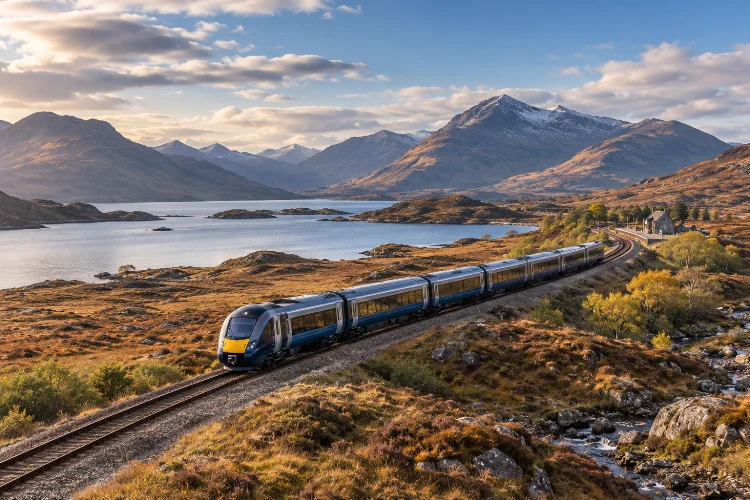
There is something unusually satisfying about seeing the Scottish Highlands from a train window.
Instead of concentrating on narrow roads, parking spaces, or the next fuel stop, you can simply watch the landscape change.
Glasgow’s suburbs gradually disappear, forests give way to open moorland, mountains appear around distant lochs, and tiny stations arrive in places where there seems to be almost nothing else.
That is why planning Scotland’s most scenic railway journeys across the Highlands can be just as rewarding as organising a traditional road trip.
Several railway lines cross landscapes that would be difficult to experience so comfortably by car. The West Highland Line travels through Rannoch Moor before reaching Fort William and Mallaig.
The Kyle Line cuts across the northwest Highlands to the coast, while the Far North Line continues through Sutherland and Caithness toward Thurso and Wick.
Add the Highland Main Line through the Cairngorms and short heritage journeys around Aviemore, and you can build an entire Highland holiday around rail travel.
The secret is not taking every train in one exhausting week. It is choosing a few routes and giving yourself time to get off.
Why Highland Rail Travel Works So Well
Driving gives you freedom, but rail travel changes the pace completely.
On a train, the journey becomes part of the destination. You can watch mountain weather developing instead of watching the road, have coffee while crossing remote moorland, or spend two hours looking through the window without feeling that you should be doing something more productive.
Scotland’s rail network is also surprisingly useful for scenic travel.
ScotRail’s current railway journey map links Glasgow with Fort William, Mallaig and Oban on the West Highland Line; Inverness with Kyle of Lochalsh on the Kyle Line; and Inverness with Thurso and Wick on the Far North Line.
The Highland Main Line connects central Scotland with Aviemore and Inverness.
This means a rail-focused itinerary does not have to be a collection of disconnected day trips.
You can travel from Glasgow into the western Highlands, reposition toward Inverness, then use the Highland capital as a base for journeys west and north.
Another advantage is weather.
Rain can spoil a mountain hike but still create fantastic railway scenery. Low cloud wraps around hills, waterfalls become stronger, and dark skies often make the Highlands look more dramatic rather than less interesting.
A grey forecast does not automatically mean a ruined train day.
The West Highland Line: Glasgow to Mallaig
If you only have time for one major Scottish railway journey, the West Highland Line is probably the strongest choice.
ScotRail describes the Glasgow-to-Mallaig journey as taking just over five hours and passing through open moorland, mountains, lochs and the famous Glenfinnan Viaduct. VisitScotland gives the broader West Highland journey at roughly five hours and fifteen minutes.
The first part of the journey gradually leaves urban Scotland behind.
After travelling northwest from Glasgow, the scenery becomes increasingly mountainous around Loch Lomond and the western Highlands.
At Crianlarich, the railway divides: one branch heads west toward Oban while the other continues north through places including Tyndrum, Rannoch and Corrour.
The section across Rannoch Moor is where the line starts feeling genuinely remote.
There are huge stretches of peatland, distant mountains and almost no obvious settlements. Corrour station is especially famous for its isolated location, and arriving there by train makes the scale of the surrounding countryside much easier to appreciate.
Then the railway approaches Fort William beneath some of Britain’s highest mountain country.
Fort William to Mallaig Is Worth the Extra Time
Stopping at Fort William is tempting, especially if you want to explore Ben Nevis, Glen Nevis or the surrounding area.
But the final railway section to Mallaig should not be skipped.
The route continues west through Glenfinnan, crosses the curved Glenfinnan Viaduct, passes Loch Shiel and Loch Eilt, and eventually reaches the coast near Arisaig, Morar and Mallaig.
VisitScotland specifically highlights the viaduct, Loch Shiel, Loch Eilt and Ben Nevis among the route’s major scenic features.
Mallaig also feels like a proper end point.
Fishing boats sit in the harbour, ferries leave for islands, and the railway effectively runs out of mainland Scotland.
Rather than travelling Glasgow–Mallaig and immediately returning on the same day, stay overnight if your schedule allows. The journey becomes far less tiring, and you gain time for coastal walks or a slower visit around Mallaig.
The Jacobite Steam Train: Famous, but Not Essential
The Jacobite is probably Scotland’s most recognisable tourist train.
Operating between Fort William and Mallaig, it covers the same spectacular stretch of railway used by regular services, including the Glenfinnan Viaduct.
Its steam locomotive and traditional carriages have become strongly associated with the Harry Potter films, even though the railway itself existed long before Hogwarts entered popular culture.
West Coast Railways publishes a Fort William – Mallaig return timetable, with morning and afternoon departure patterns listed for the 2026 season.
However, its current information also notes that 2026 operating dates have been subject to confirmation, so anyone planning specifically around the steam service should verify the latest schedule before booking accomodation or connections.
The important thing to understand is that you do not need the Jacobite to see the scenery.
Regular ScotRail trains also travel between Fort William and Mallaig and cross Glenfinnan Viaduct.
That can be a better option if your priority is flexibility rather than nostalgia.
The Jacobite is an experience. The ordinary railway is transportation through the same extraordinary landscape.
Both have value.
The Kyle Line: Inverness to Scotland’s West Coast
The Kyle Line feels quieter than the West Highland Line, and that is part of its charm.
It runs from Inverness to Kyle of Lochalsh in roughly two and a half hours, passing mountains, woodland, lochs and small Highland communities such as Achnasheen before approaching the dramatic west coast.
VisitScotland also highlights Plockton among the villages accessible along the route.
The journey begins fairly gently.
After leaving Inverness, the line reaches Dingwall and turns west. Gradually, the landscape becomes more rugged as the railway travels through Strath Bran and toward Achnasheen.
From there, the mountains begin closing in.
One of the most memorable sections comes around Strathcarron and Loch Carron, where the railway follows the water before continuing toward Plockton and Kyle of Lochalsh.
ScotRail’s own scenic touring material describes the route as moving from dense forest into wild mountain scenery before returning through Dingwall toward Inverness.
Kyle of Lochalsh Makes a Good Overnight Stop
Kyle itself is relatively small, but its location makes it useful.
The Isle of Skye sits immediately across the water, and the wider region includes mountain scenery, coastal villages and Eilean Donan Castle.
If you are designing a rail-led trip, consider staying around Kyle or nearby rather than taking the train west and immediately returning to Inverness.
That gives the railway journey a purpose.
You arrive somewhere, explore, sleep, and continue the trip rather than treating the line like a theme-park ride.
The Kyle Line is especially good for travellers who like quieter scenery. It does not have one single landmark as globally famous as Glenfinnan Viaduct.
Instead, the attraction is the gradual transition from east-coast Scotland to the mountainous west.
The Far North Line: Inverness to Thurso and Wick
The Far North Line is a different type of scenic journey.
It is less about towering mountain drama and more about distance, emptiness and seeing northern Scotland change gradually outside the window.
VisitScotland gives the Inverness-to-Thurso or Wick journey at around four and a half hours. The route travels through farmland, coastline and remote northern landscapes before passing through the Flow Country, now recognised as a UNESCO World Heritage landscape.
From Inverness, trains initially share the route toward Dingwall before heading north through Easter Ross.
The railway reaches places such as Tain, Golspie, Brora and Helmsdale, with long coastal views appearing on parts of the journey.
Then the character changes.
Beyond the east-coast settlements, the line curves inland through large areas of Sutherland and Caithness where roads, villages and buildings become much less frequent.
Stations such as Forsinard and Altnabreac emphasise just how thinly populated this part of Scotland can feel.
Build the Far North Line Into a Bigger Journey
Trying to travel Inverness–Thurso and back in one day is possible on some timetables, but it misses the point.
Stay overnight.
Thurso works as a useful base for exploring the north coast and for onward island connections, while Wick has its own harbour history and access to the eastern side of Caithness.
The line can also be broken into stages.
ScotRail’s scenic railway map highlights attractions including Dunrobin Castle and Gardens, Helmsdale’s Timespan Museum, and the Forsinard reserve along or near the Far North corridor. Some railway stops and attractions operate seasonally, so checking current schedules is neccessary.
This route rewards people who enjoy the feeling of going somewhere genuinely far away.
It is not fast.
That is exactly why it works.
The Highland Main Line: Through the Cairngorms to Inverness
The Highland Main Line tends to receive less attention than the West Highland or Kyle routes.
That is slightly unfair.
Running north from Perth toward Inverness, it travels through Pitlochry, Blair Atholl, Dalwhinnie, Newtonmore, Kingussie and Aviemore before reaching the Highland capital. ScotRail identifies the route as the main rail connection linking Perth and central Scotland with Inverness.
The route is particularly useful because it combines good scenery with practical transportation.
Around Pitlochry and Blair Atholl, wooded hills and river valleys dominate. Farther north, the railway climbs through the Drumochter area before reaching the higher interior of the Highlands.
Around Dalwhinnie, Newtonmore and Kingussie, the scenery becomes broader and more open.
Then comes Aviemore.
The town is one of the easiest rail-accessible bases for exploring Cairngorms National Park, making it ideal for a two- or three-night stop between central Scotland and Inverness.
Add the Strathspey Railway From Aviemore
If you enjoy historic trains, Aviemore offers an easy extra journey.
The Strathspey Railway operates between Aviemore, Boat of Garten and Broomhill on part of the former Highland Railway system.
VisitScotland describes the return journey as roughly 20 miles and just under two hours, passing moorland, woodland and the River Spey with Cairngorm views along the way.
Depending on the operating day, trains may use steam or heritage diesel traction.
This is not a cross-country route like the West Highland Line.
It is better treated as a relaxing half-day addition while staying in Aviemore.
Don’t Obsess Too Much About the “Best Side” of the Train
Search for Highland railway advice online and you will quickly find arguments about whether to sit on the left or right.
There can be advantages to particular sides on particular sections, but building your entire journey around this is usually unnecessary.
The lines curve constantly.
A loch that appears on one side can be replaced by mountains on the other ten minutes later. On the Kyle and West Highland lines especially, the scenery changes direction repeatedly.
Instead, prioritise a clear window.
If possible, avoid seats where large window pillars block your view.
For photography, remember that train windows create reflections. Wearing dark clothing helps, as does holding the camera close to the glass without touching it. Trying to photograph through a brightly lit carriage while the landscape outside is dark will produce far more reflections.
And occasionally put the camera down.
There is a slightly depressing version of scenic rail travel where you spend five hours looking at Scotland through your phone screen.
The view is better without it.
How to Build a 7–10 Day Highland Railway Itinerary
A comfortable Highland rail itinerary should have fewer travel days than you initially think.
For a seven-day trip, start with two nights around Glasgow or Fort William, using the West Highland Line as your major journey west. Continue to Mallaig if possible and spend a night there rather than immediately doubling back.
Then move toward Inverness for two or three nights.
From Inverness, choose either the Kyle Line or Far North Line as your next major excursion. Trying to complete both plus the West Highland route in a single week usually turns a relaxing railway holiday into a sequence of early alarms and station platforms.
With ten days, the trip becomes much better.
You can travel Glasgow – Fort William – Mallaig, spend time on the west coast, reposition toward Aviemore and Inverness, then take the Kyle Line west and still keep a couple of days for the Far North route or Cairngorms.
VisitScotland promotes longer rail-and-walk itineraries of around 13 days combining the West Highland and Kyle lines with Skye, Perthshire and Highland walking, which shows how naturally these routes can be combined when enough time is available.
The lesson is simple: don’t make every day a railway day.
Stay somewhere occasionally.
Tickets, Connections, and Practical Planning
Highland railway services are not metro systems.
On remote lines, missing one connection may mean a long wait rather than another train arriving ten minutes later.
Check the actual timetable for your travel date, particularly on the Far North, Kyle and West Highland routes. Seasonal engineering work and timetable changes can also affect journeys.
If you are making multiple Scottish rail trips, compare individual tickets with multi-day travel options.
VisitScotland currently lists the Spirit of Scotland Travelpass among options designed for broader rail travel, but prices and conditions can change, so check the current terms before buying.
Leave comfortable connection times.
A theoretical eight-minute transfer may work perfectly when everything is on schedule, but an extended Highland holiday is more enjoyable when you are not spending every journey watching the clock.
Food is another practical consideration.
Do not assume every rural station has a café or shop. Carry water and snacks, especially on the longer routes.
Booking overnight accomodation near railway stations can also simplify everything. In places such as Mallaig, Aviemore, Inverness and Kyle of Lochalsh, being able to walk from the platform to your hotel or guesthouse makes a car-free itinerary far easier.
When Is the Best Time for a Highland Rail Journey?
Late spring is difficult to beat.
May and early June bring long daylight hours, green landscapes and plenty of time for onward walks after arriving.
Summer gives even longer days but also brings higher visitor numbers. Popular accommodation around Fort William, Mallaig, Aviemore and Skye can fill quickly.
Autumn is excellent for colour.
Woodland around Perthshire and parts of the Cairngorms turns gold and copper, while lower sunlight can give mountains more depth.
Winter provides a completely different atmosphere.
Snow can make the Highland Main Line and Cairngorm scenery spectacular, while empty moorland looks even more remote under winter light. The downside is short daylight and greater potential for weather-related disruption.
Whatever season you choose, do not expect sunshine every day.
Highland railway travel is arguably at its best when the landscape keeps changing.
Planning Scotland’s most scenic railway journeys across the Highlands is less about finding one perfect train and more about connecting several very different landscapes.
The West Highland Line delivers mountains, Rannoch Moor and Glenfinnan.
The Kyle Line crosses from Inverness to the rugged west coast, while the Far North Line offers a slower journey into Sutherland and Caithness. The Highland Main Line adds Cairngorm scenery and useful stops such as Aviemore.
Give yourself enough time to leave the train as well.
Stay overnight, walk through the towns, explore a loch or take a heritage railway excursion instead of immediately boarding the next service.
Start with one major route, add a second if your schedule allows, and build the holiday around the places between the stations. Scotland’s trains are most memorable when they become part of the trip rather than simply the way you get there.